
Insurers Are Dropping Homeowners at Triple the 2018 Rate. Do This 60 Days Before Your Renewal

Last updated 09/02/2026 by
SuperMoney Team
Edited by
Andrew Latham
Summary:
New NAIC data shows homeowners insurance nonrenewals climbed between 96% and 216% depending on the region between 2018 and 2024. Premiums rose too, up 43% in the West after adjusting for inflation. The risk now isn’t just a bigger bill, it’s losing coverage entirely and having your mortgage servicer buy a worse policy for you. Three moves matter, and the best time to make them is 60 days before your renewal date.
Most coverage of the home insurance mess focuses on price. That’s the part you can see on the bill. But the National Association of Insurance Commissioners released data this month showing something more disruptive: insurers are walking away from customers at rates nobody has seen before.
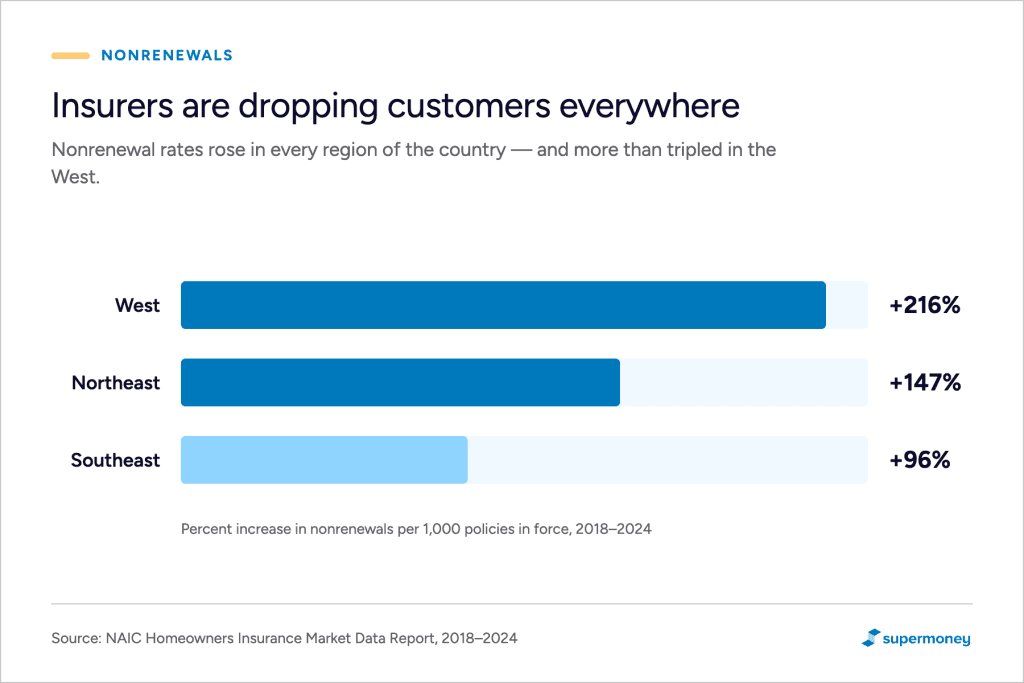
Nonrenewal rates per 1,000 policies in force rose across every region of the country between 2018 and 2024. The Southeast saw the smallest increase at 96%, which is to say the rate roughly doubled. The West went up 216%. The Northeast, generally considered the calm market, jumped 147%.
Nonrenewal rates per 1,000 policies in force rose across every region of the country between 2018 and 2024. The Southeast saw the smallest increase at 96%, which is to say the rate roughly doubled. The West went up 216%. The Northeast, generally considered the calm market, jumped 147%.
Getting nonrenewed isn’t the same as being canceled for nonpayment or letting your policy lapse. Your insurer simply decides not to offer you a new policy when the current term ends, sends a letter, and you have somewhere between 30 and 90 days, depending on your state to find another carrier. Nothing you did wrong. Your ZIP code, your roof age, or your insurer’s reinsurance costs changed. If you want the mechanics of how a homeowners policy is put together before you go shopping, start there.
Compare Home Insurance Providers
Compare multiple vetted providers. Discover your best option.
What the premium numbers actually say
You’ll see two very different average premium figures floating around, and the gap confuses people.
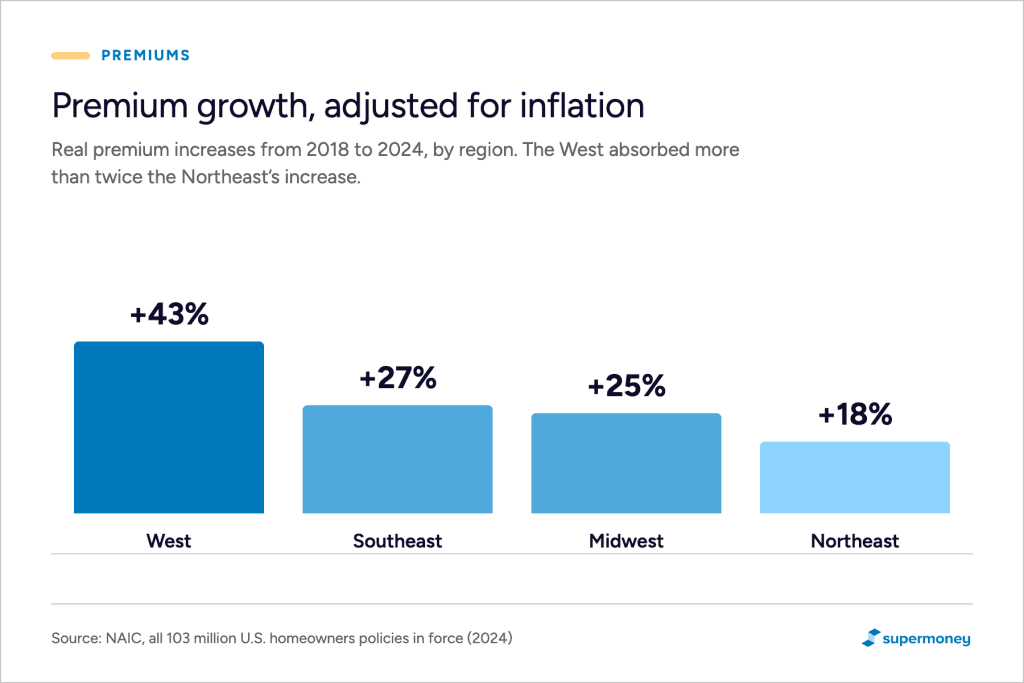
NAIC data covers all 103 million homeowners policies in force in the United States as of 2024, which includes condo and tenant forms alongside standard single-family policies. On that basis, average 2024 premiums ran $1,818 in the Southeast, the highest region, and $1,396 in the Northeast, the lowest. Adjusted for inflation, average premiums rose 18% in the Northeast, 25% in the Midwest, 27% in the Southeast and 43% in the West over the 2018 to 2024 period. Regional averages hide a lot, and the spread between individual states is wider still, which is why it’s worth checking what homeowners insurance costs in your state rather than the national number.
Insurify, which models full-coverage single-family homeowners policies specifically, projects the 2026 national average at roughly $3,057, up about 4% after a 12% jump in 2025. Florida is on track to approach $8,500.
Insurify, which models full-coverage single-family homeowners policies specifically, projects the 2026 national average at roughly $3,057, up about 4% after a 12% jump in 2025. Florida is on track to approach $8,500.
Both sets of numbers are right. They measure different things. If you own a single-family house with a mortgage and full replacement cost coverage, the higher figure is closer to your reality. If your renewal quote looks nothing like the $1,818 you read somewhere, that’s why.
The cumulative math is the part that stings. Premiums are up roughly 46% since 2021, about three times general inflation, which works out to something like $900 more a year for a typical homeowner. And no, you generally can’t write the difference off: homeowners insurance isn’t tax-deductible on a primary residence.
The escrow surprise most people miss
Here’s something the price stories skip. If your insurance is escrowed, a premium increase doesn’t just raise your annual cost. It hits your monthly mortgage payment twice.
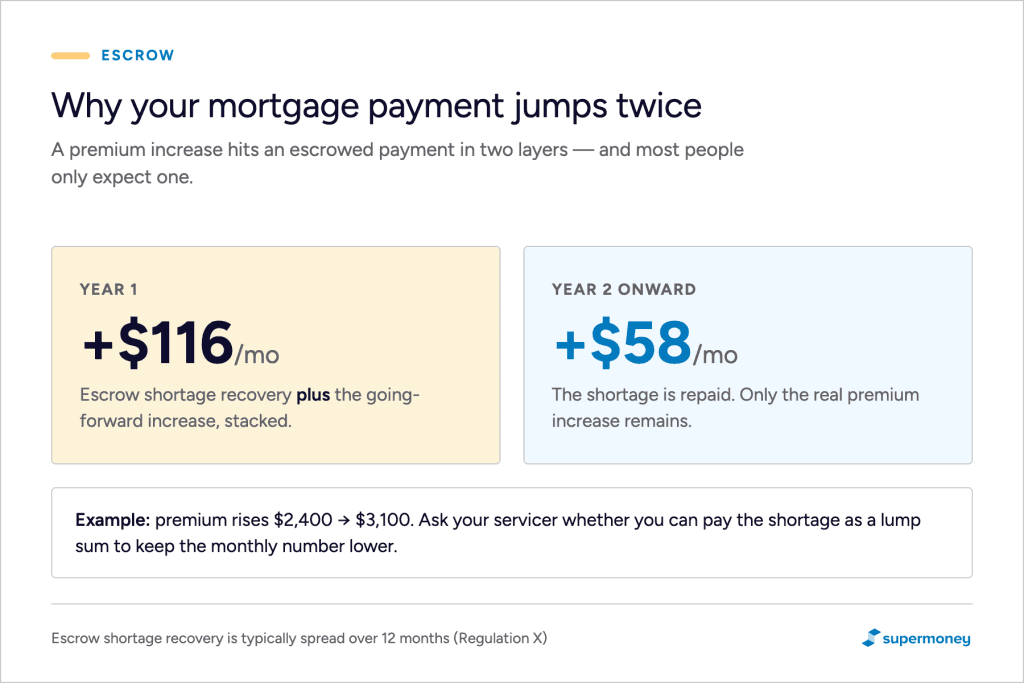
Say your premium goes from $2,400 to $3,100. Your servicer now needs $700 more per year in escrow, which is about $58 a month going forward. But the servicer also has to make up the shortage from the year that already passed, and most spread that recovery over 12 months. So your payment can jump closer to $116 a month for the first year, then settle back to $58.
Say your premium goes from $2,400 to $3,100. Your servicer now needs $700 more per year in escrow, which is about $58 a month going forward. But the servicer also has to make up the shortage from the year that already passed, and most spread that recovery over 12 months. So your payment can jump closer to $116 a month for the first year, then settle back to $58.
People open that escrow analysis letter, see their payment rising $116, assume something is broken, and call the servicer. Nothing’s broken. It’s the shortage plus the going-forward increase stacked on top of each other. Knowing that in advance means you can budget for it instead of scrambling. The same account also holds your property taxes and, if you have it, mortgage insurance, which is not the same thing as homeowners insurance even though both show up on the same line of your statement. If your lender calls it an impound account, that’s the same thing under a different name.
If you’d rather absorb the shortage in one payment and keep your monthly number lower, most servicers let you pay the escrow shortage as a lump sum. Ask. And if the new payment genuinely doesn’t fit, there are other levers for lowering a monthly mortgage payment worth looking at before you touch your coverage. Overpay into escrow and you’ll get it back eventually, but escrow refunds arrive on the servicer’s schedule, not yours.
Three moves, in order of how much they matter
1. Fix what triggers nonrenewal, starting with the roof
Roof age and condition is the single most common nonrenewal trigger, and insurers no longer wait for an inspector to drive by. They use aerial and satellite imagery, and increasingly they run it annually. A
roof past 15 to 20 years, visible curling shingles, or moss coverage can put you on the nonrenewal list without a human ever visiting. If yours is close to the line and the cash isn’t there, look at how to pay for a roof replacement before the nonrenewal letter forces the timing.
Other frequent triggers worth checking: an old electrical panel, particularly Federal Pacific or Zinsco brands, polybutylene or galvanized plumbing, an unfenced pool, a water heater past 12 years, and trampolines. Also, any dog on your insurer’s restricted breed list. Aging systems are their own budgeting problem, and it’s worth knowing what a home warranty covers versus what your policy does, because a warranty won’t stop a nonrenewal but it can keep a failed water heater from becoming a claim.
If you’re in a wildfire area, defensible space clearing and ember-resistant vents are increasingly the difference between renewed and not. In hurricane states, a FORTIFIED roof designation can earn meaningful premium credits and make you a customer carriers want to keep, and it’s worth understanding how hurricane coverage is structured before you assume you have it. Flooding is a separate matter entirely. Standard homeowners policies exclude it, so if you’re anywhere near water, price a separate policy and check what flood insurance costs in your state.
2. Shop the market 60 days before renewal, not after the letter
Waiting until you’re nonrenewed puts you in the worst possible negotiating position. A nonrenewal on record makes some carriers less interested, and you’re shopping under a deadline.
Start 60 days out. Get quotes from at least three a
dmitted carriers, and use an independent agent who writes for multiple companies rather than a captive agent who can only quote one. Independent agents know which carriers are currently writing in your area, which changes month to month, and that knowledge is worth more than any online quote tool. It still helps to walk in with a baseline, so compare homeowners insurance companies and their real customer reviews before your first call.
If admitted carriers turn you down, the excess and surplus lines market will usually write you. Understand the trade first: E&S carriers aren’t bound by the same state rate regulations, so pricing is higher and you generally lose access to your state’s guaranty fund if the insurer fails. It’s real coverage and better than nothing. Treat it as a bridge while you fix the underlying issue, not a permanent home.
The one thing you should never do is let coverage lapse and let your mortgage servicer buy force-placed insurance for you. That coverage protects the lender, not you, often costs two to three times a normal policy, and typically covers the structure only. No contents, no liability, no loss of use.
3. Raise your deductible on purpose, not by accident
Moving from a $1,000 deductible to $2,500 typically cuts a premium by roughly 7% to 11%. On a $3,057 premium, call the savings $300 a year.
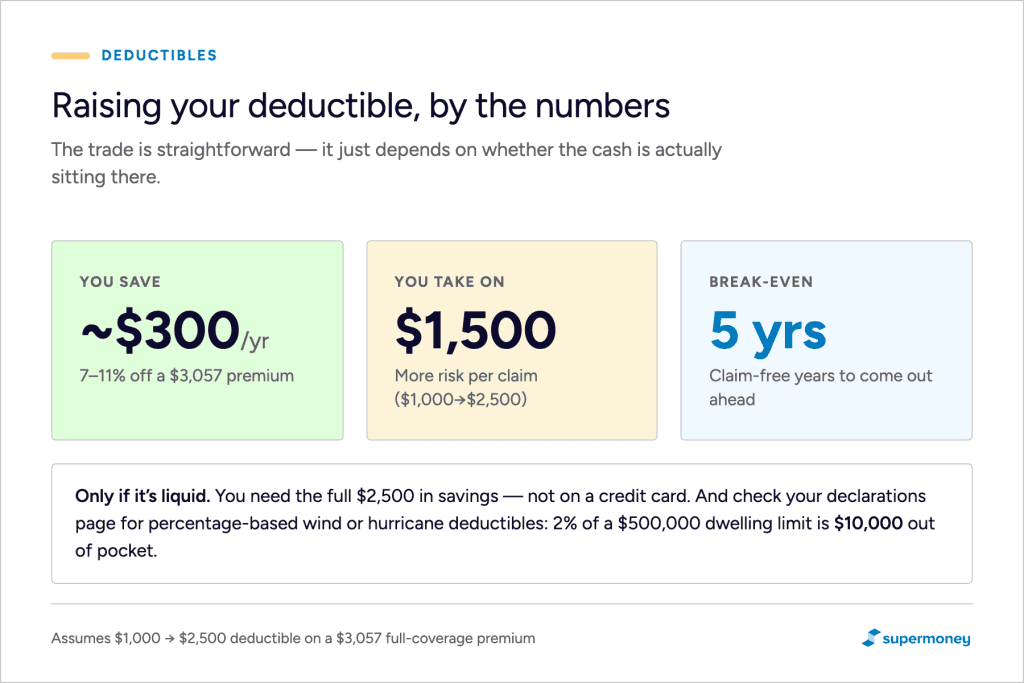
Run the break-even. You’re taking on $1,500 more risk to save $300 a year, so the math works if you go five years or more between claims. Most homeowners do, and that’s before you account for the fact that filing small claims is itself a nonrenewal risk. If you have $2,500 sitting in savings, the higher deductible is usually the better deal.
If you don’t have $2,500 in savings, don’t do this. A deductible you can’t pay isn’t a discount, it’s a delayed emergency. This is exactly the job an emergency fund does, and if you’re not sure how much you should have in emergency savings, size it around your deductible first and your monthly expenses second. Then make sure it’s in one of the best places to keep an emergency fund, where it earns something and you can still reach it the day the roof comes off.
Watch for percentage deductibles too. Hurricane, wind and hail deductibles are often written as a percentage of dwelling coverage rather than a flat dollar amount. A 2% wind deductible on a $500,000 dwelling limit is $10,000 out of pocket. Read that line on your declarations page and make sure you know the number.
Don’t cut coverage to make the number look better
The tempting move when a premium jumps is to lower the dwelling limit. Resist it.
Rebuilding costs have risen faster than home values in a lot of markets, and being underinsured triggers the coinsurance penalty on most policies. Insure the structure for less than 80% of replacement cost and your insurer can reduce even a partial claim payment proportionally. You save $200 a year and lose $40,000 on a kitchen fire. If you’ve never run the number, work out how much dwelling coverage you actually need before you touch that limit.
If you need to trim, trim in this order: raise the deductible, drop optional endorsements you don’t need, bundle auto and home with the same carrier, then ask your agent to run every available credit (new roof, monitored alarm, water shutoff device, claims-free, paid-in-full, autopay). Cutting the dwelling limit is last, and usually shouldn’t happen at all.
Insurance is one of those bills that quietly grows while you’re not looking, which is exactly why it’s worth tracking as a line item rather than a mystery inside your mortgage payment. The SuperMoney app can surface what you’re actually spending on housing costs month over month, including escrow changes, so a $116 jump registers as something you noticed in advance rather than something you discover in a letter.
Remember this
Rate increases are annoying. Losing coverage is the actual emergency, and the NAIC data says it’s happening two to three times as often as it did in 2018. Handle the roof, shop early with an independent agent, and set a calendar reminder 60 days before your renewal date. That reminder is worth more than any single line item on your policy.
Key takeaways
- Nonrenewal rates per 1,000 policies rose 96% in the Southeast and 216% in the West between 2018 and 2024
- Inflation-adjusted average premiums rose 18% in the Northeast, 25% in the Midwest, 27% in the Southeast and 43% in the West over the same period
- Insurify projects the 2026 national average full-coverage premium at about $3,057, up 4% after a 12% jump in 2025
- Premiums are up roughly 46% since 2021, about three times general inflation, or about $900 a year for a typical homeowner
- Moving from a $1,000 to a $2,500 deductible saves roughly $300 a year and breaks even in about five claim-free years
- There were 103 million homeowners insurance policies in force in the U.S. as of 2024
Related reading
- How to find home insurance that covers appliances
- How insurance premiums are calculated
- Flood insurance: the complete SuperMoney library
- How to calculate your monthly mortgage payment
- Personal finance beginner’s guide
Share this post:
Add as a preferred source on Google
Table of Contents