
That Black Friday Store Card Discount Costs More Than You Think. Do the Math First

Last updated 11/08/2026 by
SuperMoney Team
Edited by
Andrew Latham
Summary:
That 20% off at the register comes with a store card that averages about 31% APR. Carry a $400 balance and the interest eats your $100 discount in roughly nine months. Take the deal only if you’ll pay the card off in full every month, and never trust a “no interest if paid in full” promo you can’t clear before it ends.
Black Friday is November 27 this year, and the pitch is already showing up in your inbox. Open a store card today, take 20% to 30% off your entire purchase. The cashier asks at checkout. The line behind you is growing. You say yes.
I get it. A discount feels like free money. But the store isn’t giving you a gift. It’s selling you a high-interest loan and using the discount as bait. Let’s put real numbers on it.
Compare Credit Cards
Compare the rates, fees, and rewards of leading credit cards.
What store cards really charge
The Consumer Financial Protection Bureau (CFPB), the federal agency that supervises credit card issuers, found that new store cards from the 100 biggest retailers averaged 32.66% APR. Its December 2025 report put the 2024 average at 31.3% for store cards, against 25.2% for regular credit cards. More than 90% of retail cards had a maximum APR above 30%, and nearly one in five topped 35%.
Bankrate’s 2025 survey of 110 cards landed in the same neighborhood: a 30.14% average retail APR, with 63 of the 110 cards above 30%. Even after the Federal Reserve cut rates, 23 of those cards raised theirs.
Translation: the rate on that card is roughly 10 points higher than the average regular card, and it will not drop just because you asked nicely.
The discount math (it’s worse than you think)
Say you buy $500 of stuff with 20% off. You save $100 and owe $400. If you carry that $400 on a card at 32.66% APR, the interest runs about $10.89 a month. After roughly nine months of carrying the full balance, you’ve paid back the entire $100 discount in interest. Month ten, you’re losing money on the “deal.”
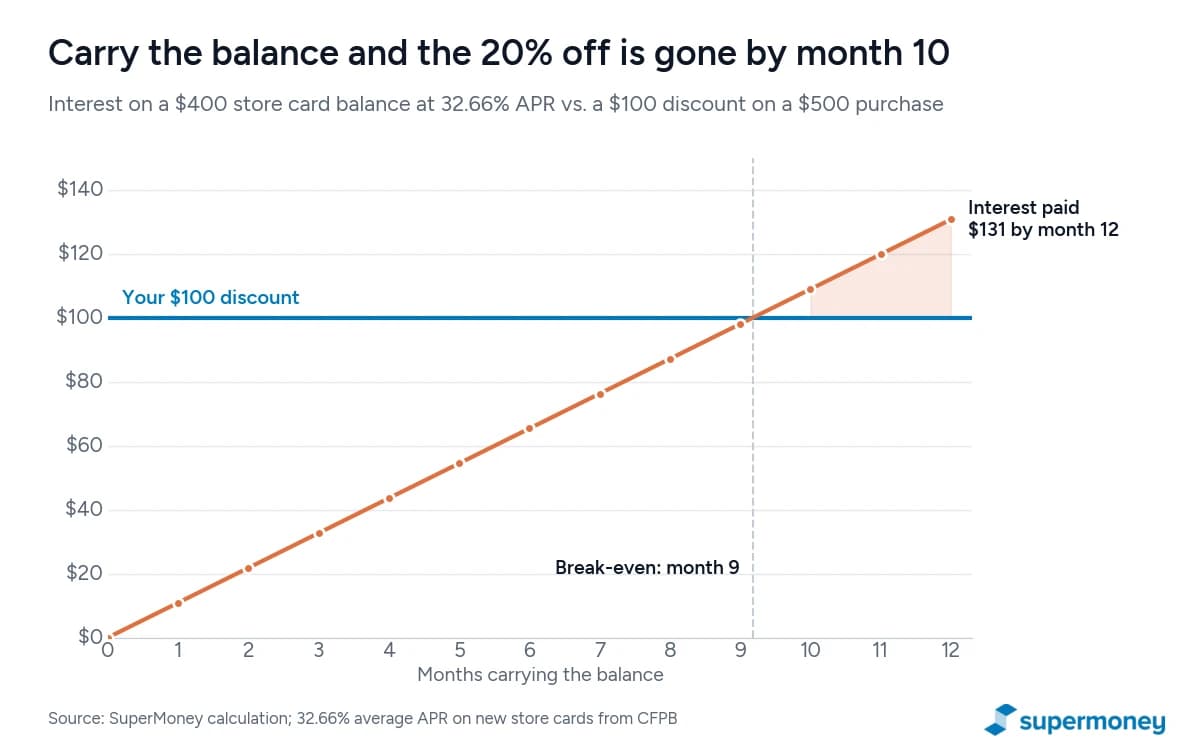
Pay it down faster and the math improves. Pay it off in full on the first statement and you keep the whole discount. That’s the only scenario where the store card clearly wins. Be honest with yourself about which one you are.
The deferred interest trap
This is the one that hurts people most. Furniture, electronics, and appliance stores love to advertise “no interest if paid in full within 12 months.” That is not the same as 0% APR.
With a 0% APR card, interest starts only after the promo ends, on whatever balance is left. With deferred interest, the store tracks interest the whole time and adds all of it if you’re short by even one dollar when the promo ends.
Here’s the real-world version. You buy a $4,500 sofa on a 12-month deferred-interest plan at 31.99% APR. You pay faithfully and have $180 left on the last day. The card can then charge all the interest that has been building on your balance since the day you bought it. Paying $360 a month, that comes to about $806. You owed $180 and now you owe about $986.
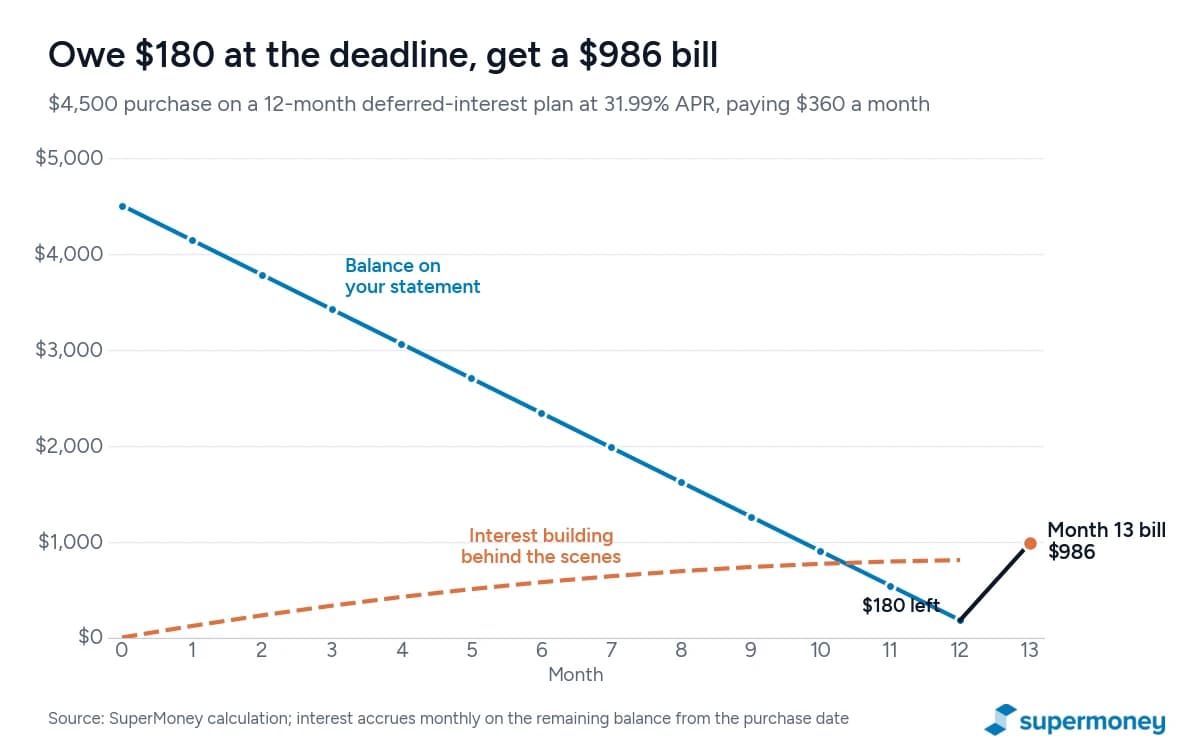
The CFPB has found that about a fifth of deferred-interest balances end up with retroactive interest. Minimum payments almost never clear the balance in time, because the minimum is set below what you’d need. If you do sign up for one of these, divide the purchase price by the number of promo months, subtract a month for safety, and pay at least that amount every month. For the sofa, that’s $4,500 divided by 11, about $410 a month.
Late fees and your credit score
Store cards lean on fees too. Late fees made up about 25% of store card interest and fees, compared with 7% for general-purpose cards, according to the CFPB’s findings as reported by MoneyTalksNews. If you plan to pay on time, they won’t hit you. If you forget one statement during the holidays, they will.
Then there’s your credit. Every application can trigger a hard inquiry. Store cards also tend to come with small credit limits, which is a utilization problem. Put a $400 purchase on a card with a $1,000 limit and you’re at 40% utilization on that account right away. Scores tend to drop once utilization climbs past 30%. Open three of these in a month and lenders notice, which matters if you’re about to apply for a mortgage or car loan.
What to do instead
You have better options, and none of them require being a saint about spending.
If you already have a regular rewards card with a decent rate, use it. Ask the cashier whether the discount applies without opening an account. Sometimes it does. Check the retailer’s website too, since a lot of stores offer the same sale price online without a card.
If you really need to spread out a big purchase, a card with a true 0% intro APR (not deferred interest) is the safer move. Read the terms and confirm the words “0% intro APR” appear, and mark the end date in your calendar.
And if you do open a store card, treat it like a debit card. Set up autopay for the full statement balance the same day you apply. That’s the habit that separates people who save from people who pay 31%.
A quick checkout script
Before you say yes to that cashier, ask three questions. What’s the APR? Is the promo deferred interest or a true 0% rate? And can I get today’s discount without the card? If they can’t answer the first two clearly, that tells you something. You can always say “no thanks” and open the card later if it still makes sense.
Where the SuperMoney app helps
The hardest part of holiday spending is keeping track of it. With the SuperMoney app, you can link your accounts and cards, watch your spending in one place, and see your balances as they build through November and December. If you’ve already got a balance you’re carrying into January, that same view helps you decide how fast to pay it down.
Key takeaways
- New store cards from the 100 biggest retailers averaged 32.66% APR, per the CFPB.
- Store cards averaged 31.3% in 2024 versus 25.2% for regular cards.
- A $100 discount disappears in about nine months if you carry a $400 balance at 32.66%.
- Missing a 12-month deferred-interest payoff by $180 on a $4,500 purchase at 31.99% can add about $806 in back-interest.
- Black Friday is November 27, 2026. Decide before you reach the register.
Share this post:
Add as a preferred source on Google
Table of Contents