
The 52-Week Savings Challenge: Charts, Variations, and How to Stay on Track

Last updated 03/04/2026 by
Andrew Latham
Edited by
Andrew Latham
Summary:
The 52-week savings challenge builds your savings gradually by depositing $1 in week one, $2 in week two, and so on for a full year — totaling $1,378 by week 52. Variations like the reverse method, biweekly schedule, or flat-rate approach let you customize the challenge to match your paycheck cycle and budget.
Saving $1,378 sounds ambitious until you realize the first deposit is a single dollar. The 52-week savings challenge turns that dollar into momentum — and by the time higher deposits arrive, the habit is already built.
Whether you follow the classic weekly version, reverse it to front-load the hard weeks, or adapt it to a biweekly paycheck schedule, the math always works. The only variable is whether you start.
Compare Savings Accounts
Compare savings accounts. Discover your best option.
What Is the 52-Week Savings Challenge?
The 52-week savings challenge is a year-long savings method where you deposit an increasing amount of money each week. Week one, you save $1. Week two, $2. Week three, $3. The pattern continues until week 52, when you deposit $52.
The math behind it is a simple arithmetic sequence: 1 + 2 + 3 + … + 52 = $1,378. That’s enough to start a meaningful cash cushion or knock out a specific financial goal.
If you deposit into a high-yield savings account earning 4.5% APY, you’ll earn roughly $30–$35 in interest on top of the $1,378 — not life-changing, but it’s free money you wouldn’t earn keeping cash in an envelope or a checking account.
What makes the challenge effective isn’t the total — it’s the structure. Starting small removes the psychological barrier that stops most people from saving. By the time the weekly amounts feel significant, the habit is already locked in.
The challenge also creates visible progress. Crossing off week 10 or watching your balance pass $200 triggers the same reward loop that makes fitness trackers addictive. Behavioral economists call this “goal gradient acceleration” — the closer you get to a milestone, the harder you work to reach it.
How to Start the 52-Week Savings Challenge
You can begin the 52-week challenge any week of the year — it doesn’t need to start in January.
- Open a dedicated savings account. Keep challenge money separate from your checking account to avoid spending it. A high-yield savings account lets your deposits earn interest while you save.
- Pick your variation. The standard version starts at $1 and adds $1 per week. If holiday spending worries you, try the reverse method — start with $52 and work down. Biweekly savers can adapt the schedule to match their paycheck (see variations below).
- Set up automatic transfers. Schedule weekly transfers from checking to savings so you don’t have to remember each deposit. Most banks let you set up recurring transfers on a specific day of the week.
- Track your progress. Use a printable chart, a spreadsheet, or a budgeting app to check off each week. Visual progress is one of the strongest motivators for completing the full 52 weeks.
- Choose your savings goal. Decide upfront what the $1,378 is for — an emergency fund, a vacation, a debt payment, or a holiday spending buffer. A specific target makes it harder to quit.
Pro tip: If you’re starting mid-year, the reverse version has a hidden advantage. Beginning in July with $52 deposits means the smallest deposits ($1–$5) land in November and December — exactly when most budgets are already stretched by holiday spending. Timing your variation to your calendar is just as important as picking the right amount.
How Much Will You Save? (Week-by-Week Milestones)
The 52-week challenge feels slow at first. After four weeks, you’ve saved just $10. But the compounding structure accelerates quickly — and seeing the milestones ahead makes it easier to stay committed.
| Week | Weekly Deposit | Cumulative Total | Milestone |
|---|---|---|---|
| Week 4 | $4 | $10 | First double digits |
| Week 13 | $13 | $91 | Quarter one complete |
| Week 20 | $20 | $210 | Passed $200 |
| Week 26 | $26 | $351 | Halfway point |
| Week 33 | $33 | $561 | Passed $500 |
| Week 39 | $39 | $780 | Three-quarters done |
| Week 45 | $45 | $1,035 | $1,000 milestone |
| Week 52 | $52 | $1,378 | Challenge complete |
Notice how more than half the total comes from the final 13 weeks. That back-loaded structure is both the challenge’s strength and its risk — which is why the reverse variation exists.
Why Americans Need a Savings System
A 2025 Bankrate survey found that 24% of Americans have no emergency savings at all. Another 30% have some savings but not enough to cover three months of expenses.
The same survey found that only 41% of Americans could cover a $1,000 emergency expense from savings — down from 44% the previous year. The rest would rely on credit cards, borrowing, or cutting expenses elsewhere.
And it’s not just about the dollar amounts. Bankrate’s data shows that 60% of Americans are uncomfortable with their level of emergency savings. That discomfort creates a cycle: money stress leads to avoidance, avoidance leads to no plan, and no plan leads to no savings.
The 52-week challenge breaks that cycle by replacing willpower with structure. A 2025 NerdWallet survey found that 43% of Americans with savings accounts transfer money at random intervals “as they have extra money.” The problem with random transfers is that “extra money” rarely materializes — because expenses expand to fill available income.
Behavioral economists call this the commitment device effect. When you commit to a specific amount on a specific schedule, the decision is already made — you don’t have to choose between saving and spending each week. The 100 envelope challenge uses the same principle with daily deposits instead of weekly ones.
The 52-week challenge adds another layer: escalating commitment. Because the first deposits are tiny, the psychological cost of starting is near zero. By the time $30 or $40 weekly deposits arrive, you’ve already built 30 weeks of evidence that you can save consistently. That track record is more powerful than any budgeting spreadsheet.
5 Ways to Customize the 52-Week Challenge
The standard version doesn’t fit every budget or paycheck cycle. These variations produce similar results while adapting to real-life constraints.
1. Reverse 52-Week Challenge
Start with $52 in week one and decrease by $1 each week. You’ll save the same $1,378, but the heaviest deposits happen in January when motivation is highest — not in December when holiday spending peaks.
2. Biweekly Challenge (26 Paychecks)
If you’re paid every two weeks, save every other week instead. Deposit $3 the first pay period, add $3 each time ($3, $6, $9, $12…), and you’ll save $1,053 across 26 paychecks. The most you’ll ever deposit is $78 — and it’s timed to when money actually hits your account.
The biweekly savings challenge is the most underrated variation because it eliminates the biggest friction point: timing. Weekly challenges require deposits even on weeks when no paycheck arrives. Biweekly deposits happen only on paydays, so there’s never a gap between income and savings.
3. Flat-Rate Weekly Challenge
Skip the escalating deposits entirely. Save $26.50 every week for 52 weeks and you’ll hit the same $1,378 total. This works best for people who automate their savings and don’t want to track changing amounts.
4. Double-Up Challenge ($2,756 Target)
Multiply every deposit by two: $2 in week one, $4 in week two, and so on up to $104 in week 52. Total saved: $2,756. This variation works for higher earners or anyone who finishes the standard challenge and wants a bigger goal.
5. Custom-Target Challenge
Pick your savings goal first, then reverse-engineer the weekly deposit. Want $5,000? Save $96.15 per week flat, or start at $2 and add $2 each week (ending at $104, totaling $2,756) and supplement with a lump-sum deposit. Want $10,000? That’s $192.31 per week — aggressive, but achievable for dual-income households.
| Variation | Schedule | Deposit Range | Total Saved | Best For |
|---|---|---|---|---|
| Standard | Weekly (52 weeks) | $1 – $52 | $1,378 | Beginners building the savings habit |
| Reverse | Weekly (52 weeks) | $52 – $1 | $1,378 | People who want lighter December deposits |
| Biweekly | Every 2 weeks (26 pay periods) | $3 – $78 | $1,053 | Workers paid every other week |
| Flat-rate | Weekly (52 weeks) | $26.50 each | $1,378 | Automators who want set-it-and-forget-it |
| Double-up | Weekly (52 weeks) | $2 – $104 | $2,756 | Higher earners or second-round challengers |
52-Week Challenge vs. Other Savings Methods
The 52-week challenge isn’t the only structured savings method. How it compares to alternatives depends on your timeline, income stability, and savings goal.
The 100 envelope challenge saves $5,050 in roughly 100 days using daily cash deposits numbered $1 through $100. It’s faster and produces a larger total, but the daily commitment and cash-only format don’t work for everyone. The 52-week challenge is slower and more forgiving — weekly deposits instead of daily, and fully compatible with digital transfers.
Automatic fixed transfers (like saving $200/month via direct deposit) are the simplest approach. No tracking, no escalation, no weekly decisions. But they lack the gamification that keeps people engaged. A Bankrate survey found that 53% of American workers say saving consistently feels difficult or impossible — suggesting that structure and motivation matter as much as automation.
Round-up apps save spare change by rounding purchases to the nearest dollar. They’re frictionless, but the amounts are tiny — most users save $30–$50 per month through rounding alone. The 52-week challenge produces $1,378 in the same timeframe, with more predictable weekly totals.
No single method is best for everyone. The strongest savings strategy often combines two approaches: a challenge for engagement and automatic transfers for consistency. Run the 52-week challenge to build the habit, then convert to automated weekly transfers once the year ends.
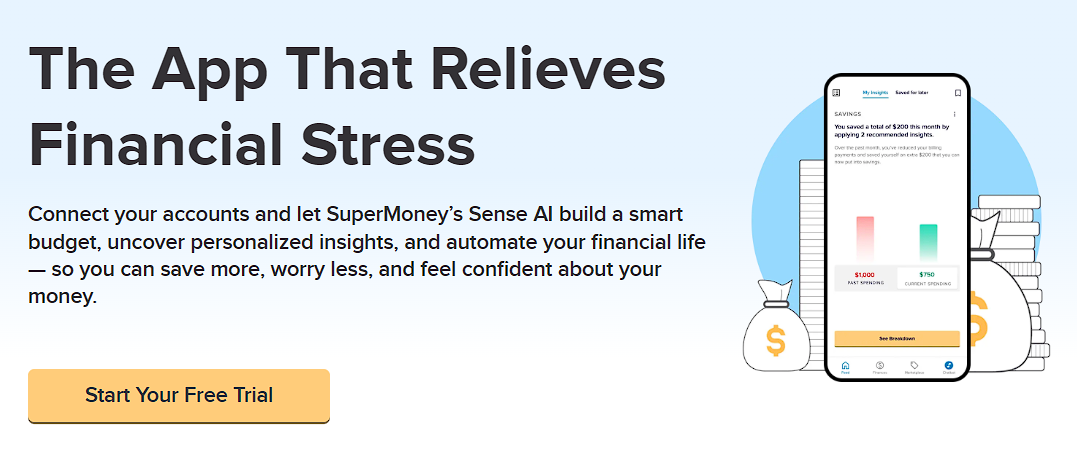
Set up automatic weekly transfers that match your challenge
The SuperMoney app helps you automate savings transfers on your schedule — weekly, biweekly, or monthly. Set your challenge target, connect your bank account, and let automatic deposits do the work.
How to Find the Money for Weekly Deposits
The 52-week challenge doesn’t require extra income — it requires knowing where your current income goes. A budget framework tells you exactly how much is available for savings each week.
The 50/30/20 budget rule allocates 20% of after-tax income to savings and debt. For someone earning $4,000 per month, that’s $800 — more than enough to cover even the highest weeks of the challenge.
If 20% feels out of reach, the 80/20 rule simplifies the split: spend 80%, save 20%. No subcategories, no tracking individual expenses. Just one number to hit.
For tighter budgets, start with the reverse challenge so the largest deposits land when motivation is fresh. Or try the flat-rate version at a lower amount — even $10 per week for 52 weeks produces $520, which covers most common emergencies. Budgeting on a low income doesn’t mean saving nothing — it means starting smaller.
Another approach: fund the challenge with money you’re already spending. Track one week of discretionary purchases — coffee, streaming services, impulse buys — and redirect one or two of those costs into your challenge deposit. The first 13 weeks require less than $15 per week, which is often hiding in subscriptions or convenience purchases.
If you live paycheck to paycheck, the biweekly version is the most realistic entry point. It ties every deposit directly to a paycheck, starts at just $3, and never exceeds $78 — making it manageable even on tight margins.
3 Mistakes That Derail the 52-Week Challenge
1. Keeping challenge money in your checking account
If savings sit next to spending money, they get spent. The key difference between checking and savings accounts is access — and for this challenge, you want less of it.
Open a separate savings account — ideally one without easy debit access. The friction of having to initiate a transfer to withdraw is often enough to protect your challenge balance from impulse spending.
2. Skipping a week and never catching up
Missing a deposit isn’t failure — it’s friction. If you miss week 30 ($30), add it to week 31 ($31 + $30 = $61). Or use a “bingo” approach: instead of sequential deposits, cross off any unchecked amount each week based on what you can afford.
The bingo method is especially useful for people with irregular income. Flush week? Cross off a higher number. Tight week? Grab a low one. You still hit $1,378 as long as all 52 numbers get checked.
3. Not having a specific goal
Saving $1,378 “just because” makes it easy to raid the fund when a sale or impulse hits. Naming the goal — emergency fund, vacation, car repair buffer — creates psychological ownership. The 30-day rule can help you resist withdrawing for impulse purchases.
What to Do With $1,378 When You Finish
Completing the challenge means you have a lump sum and a proven savings habit. Both are valuable — but what you do next depends on where you are financially.
- Start or grow an emergency fund. Financial experts recommend 3–6 months of expenses in accessible savings. If $1,378 covers one month, you’ve built the foundation — now keep going. A high-yield savings account lets the balance grow while you continue building.
- Pay down high-interest debt. A $1,378 lump payment on a credit card charging 24% APR saves you over $330 in first-year interest alone. If you’re weighing debt payoff vs. savings priority, the interest rate math usually decides.
- Fund a sinking fund. Know you’ll need new tires, a holiday gift budget, or an annual insurance payment? A sinking fund turns predictable expenses into planned savings categories instead of surprise charges.
- Start the next challenge. Run the double-up version for $2,756, or switch to the 100 envelope challenge for a faster pace with daily deposits totaling $5,050.
- Build a full automated money system. The savings habit you’ve built is the hardest part. Now automate it permanently — set up recurring transfers that replace the challenge structure with a system that runs without weekly decisions.
- Consider investing the next round. Once your emergency fund and short-term goals are covered, future challenge savings could go into a Roth IRA instead of a savings account for long-term growth potential.
For those ready to aim higher, the $1,378 habit is a proven foundation for hitting a $10,000 annual savings goal — the math just requires stacking additional savings vehicles on top of the challenge.
Key takeaways
- The standard 52-week challenge saves $1,378 by depositing $1 in week one, $2 in week two, and increasing by $1 each week through week 52.
- The reverse variation front-loads larger deposits when motivation is highest, making it easier to finish during expensive holiday months.
- A biweekly version ($3 increments across 26 pay periods) saves $1,053 and aligns deposits with your paycheck schedule.
- Separate your challenge savings from your checking account — out of sight, out of reach.
- Once you finish, the savings habit matters more than the $1,378. Automate your next goal or scale up with the double-up or 100 envelope challenge.
FAQ
How much money do you save with the 52-week challenge?
The standard 52-week challenge saves $1,378 over one year. The reverse version saves the same amount. The biweekly version saves $1,053 across 26 pay periods, and the double-up variation totals $2,756.
Can I start the 52-week challenge mid-year?
Yes. The challenge runs for 52 consecutive weeks regardless of when you start. Beginning in June means you finish the following May. The calendar doesn’t affect the math — only consistency does.
What if I can’t afford the higher weekly amounts?
Try the reverse method to front-load the largest deposits. Or use the flat-rate version at a comfortable amount — even $10 per week for 52 weeks saves $520. You can also use the bingo approach, crossing off any amount each week based on what your budget allows.
Where should I keep my 52-week challenge savings?
A high-yield savings account is the best option. Your deposits earn interest while remaining accessible, and keeping the money in a separate account reduces the temptation to spend it. A money market account is another option if you want slightly higher rates with check-writing access. Avoid keeping cash at home — it earns nothing and is easy to dip into.
Is the 52-week challenge better than the 100 envelope challenge?
They serve different goals. The 52-week challenge saves $1,378 over 12 months with weekly deposits, making it a slower, steadier habit builder. The 100 envelope challenge saves $5,050 in about 3.5 months with daily deposits, making it faster but more demanding. Choose based on your timeline and budget capacity.
How do I automate the 52-week challenge?
The simplest approach is the flat-rate variation: set up a recurring $26.50 weekly transfer from checking to savings. For the escalating version, some banks and budgeting apps let you schedule increasing transfers. If your bank doesn’t support variable automation, set calendar reminders and manually adjust the transfer amount each week.
What’s the best variation for someone paid biweekly?
The 26-paycheck biweekly version. Deposit $3 on your first paycheck, increase by $3 each pay period, and save $1,053 over the year. Every deposit is tied to a paycheck, so the money is always available when the transfer hits.
Put your savings challenge on autopilot
Track your weekly deposits, set savings goals, and automate transfers — all in one place. The SuperMoney app turns a 52-week challenge into a system that runs itself.
Andrew is the Content Director for SuperMoney, a Certified Financial Planner®, and a Certified Personal Finance Counselor. He loves to geek out on financial data and translate it into actionable insights everyone can understand. His work is often cited by major publications and institutions, such as Forbes, U.S. News, Fox Business, SFGate, Realtor, Deloitte, and Business Insider.
Share this post:
Add as a preferred source on Google
Table of Contents