
The Conscious Spending Plan: What It Is, How It Works, and How to Build

Last updated 03/06/2026 by
Andrew Latham
Edited by
Andrew Latham
Summary:
A conscious spending plan is a budgeting framework that allocates income into four fixed categories: needs, savings, investments, and guilt-free spending, so that every dollar is assigned a purpose before the month begins. Unlike traditional budgets that focus on restriction, the framework is designed around spending freely on things you value while cutting aggressively on things you don’t.
Most budgets fail because they treat all discretionary spending as the enemy.
The conscious spending plan works differently: it builds guilt-free spending directly into the structure, so the goal isn’t to stop spending — it’s to spend deliberately on what actually matters to you. The practical implication is that how to stop spending on things you don’t need becomes less of a willpower question and more of a design question — you build the cuts into the structure before the month begins.
Take control of your financial future
SuperMoney's AI-powered budgeting and personalized financial insights help you reduce financial stress and achieve your goals faster.
What is a conscious spending plan?
A conscious spending plan is a personal finance framework developed by Ramit Sethi in his book I Will Teach You to Be Rich. It allocates after-tax income into four categories using fixed percentage ranges, automates savings and investments first, and leaves the remainder for living expenses and discretionary spending without guilt or ongoing tracking.
The core philosophy separates it from conventional budgeting: instead of tracking every purchase and categorizing every grocery trip, you automate the important decisions upfront and spend the rest freely. The discipline is in the system design, not in ongoing willpower.
A spending plan more broadly refers to any framework that assigns income to specific purposes in advance, as opposed to reviewing spending after the fact.
The conscious spending plan is one implementation; others include zero-based budgeting and percentage-based frameworks like the 50/30/20 rule. What distinguishes a spending plan from a budget is intent: a spending plan is proactive, a budget is typically reactive.
The four categories and allocations
The framework divides take-home pay into four buckets. The percentages are ranges — your actual split will depend on income, location, and life stage.
| Category | Allocation | What it covers |
|---|---|---|
| Fixed costs | 50–60% | Rent or mortgage, utilities, insurance, groceries, minimum debt payments, core subscriptions |
| Savings | 5–10% | Emergency fund, short-term savings goals (travel, car, home down payment) |
| Investments | 5–10% | 401(k) contributions, Roth IRA, brokerage account — money that grows long-term |
| Guilt-free spending | 20–35% | Everything else: dining out, clothing, entertainment, hobbies, whatever you genuinely enjoy |
The ordering matters. Fixed costs and automated savings and investments come out first — before guilt-free spending is calculated. Whatever remains after those three categories is yours to spend on whatever you want without tracking or justifying individual purchases.
The U.S. personal savings rate, tracked by the Federal Reserve Bank of St. Louis, has averaged between 3–6% for most of the past decade, well below the 5–10% savings target in this framework. For most households, this plan isn’t restrictive; it’s an upgrade to what’s already happening by default.
How to build your conscious spending plan
Complete this once using your last month’s take-home pay. The whole process takes about 30 minutes.
- Calculate your monthly take-home pay. Use your actual after-tax income — what hits your bank account, not your gross salary. If your income varies month to month, use a three-month average as your baseline.
- Total your fixed costs. List every expense that recurs monthly at a fixed or predictable amount: rent, utilities, insurance premiums, minimum loan payments, and subscriptions you’d keep regardless of budget pressure. These should fall between 50–60% of take-home pay. If they exceed 60%, look for one significant reduction — housing, a car payment, or insurance are the highest-leverage categories.
- Set your savings and investment targets. Assign 5–10% to savings (emergency fund first, then specific goals) and 5–10% to investments (start with any employer 401(k) match — that’s an immediate 50–100% return on those dollars). Set both as automatic transfers that execute on payday, before you have access to the money.
- Calculate your guilt-free spending. Subtract fixed costs, savings, and investments from your take-home pay. Whatever remains is your guilt-free spending budget — the full amount, to use however you want with no line-item tracking required.
- Automate the first three categories. Set up automatic transfers for savings and investment contributions on payday. Schedule fixed-cost payments by autopay where possible. Once automation is running, the only active spending decision each month is how to use your guilt-free allocation.
Pro tip: The most common mistake when building a conscious spending plan is underestimating fixed costs. Pull 90 days of bank and card statements before filling in that category — most people find two or three recurring charges they forgot to count. Getting fixed costs accurate upfront prevents the guilt-free allocation from evaporating in the first week of the month.
Conscious spending plan template
Use this template to map your own plan. Fill in your monthly take-home pay and work through each row in order.
| Category | Target % | Your target ($) | Your actual ($) | Gap |
|---|---|---|---|---|
| Monthly take-home pay | 100% | $_____ | $_____ | — |
| Fixed costs (rent/mortgage, utilities, insurance, groceries, minimum debt payments, core subscriptions) | 50–60% | $_____ | $_____ | $_____ |
| Savings (emergency fund, short-term goals) | 5–10% | $_____ | $_____ | $_____ |
| Investments (401k, Roth IRA, brokerage) | 5–10% | $_____ | $_____ | $_____ |
| Guilt-free spending (remainder) | 20–35% | $_____ | $_____ | $_____ |
The gap column shows where your current spending deviates from the target. A positive gap in fixed costs means you’re over-allocated there and have less guilt-free spending available than the framework intends. A negative gap in savings or investments means those categories are being underfunded.
Accurately placing expenses in fixed costs versus guilt-free spending requires knowing what counts as a need versus a want. A gym membership might be a fixed cost for one person and discretionary for another — the line isn’t always obvious until you examine it deliberately.
Build your conscious spending plan in minutes
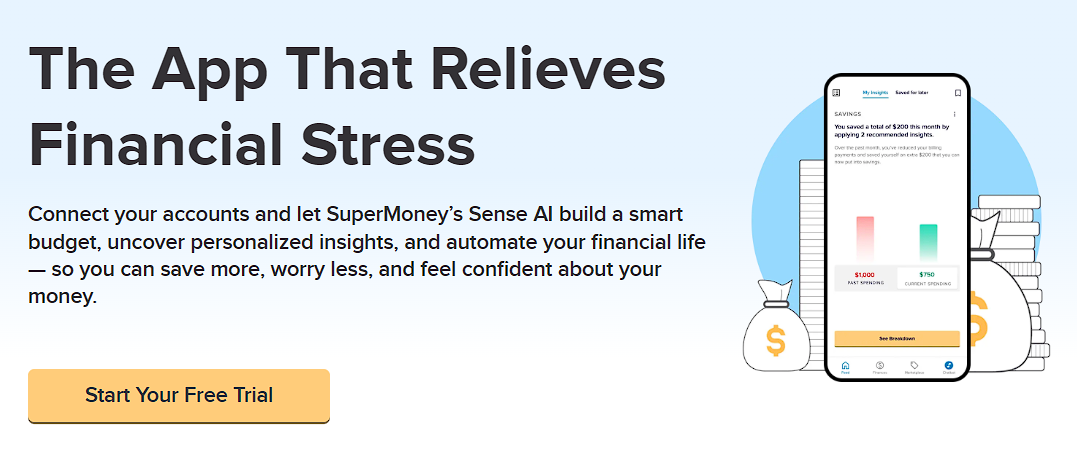
The SuperMoney app connects your accounts, categorizes your spending automatically, and maps it against your four-category allocation — so you can see your actual split versus your target without building a spreadsheet from scratch.
Conscious spending plan vs. 50/30/20 vs. zero-based budgeting
All three frameworks assign income to categories in advance. The differences are in philosophy, flexibility, and how much ongoing effort they require.
| Factor | Conscious Spending Plan | 50/30/20 Rule | Zero-Based Budgeting |
|---|---|---|---|
| Core philosophy | Automate savings and investments, spend the rest guilt-free | Split income across three fixed percentage buckets | Assign every dollar a job — income minus all expenses equals zero |
| Savings allocation | 5–10% savings + 5–10% investments (separate categories) | 20% combined (savings + debt payoff) | Savings is a budget line like any other expense |
| Tracking required | Minimal — automate and spend freely within guilt-free budget | Moderate — monitor category totals monthly | High — every dollar assigned and reconciled each month |
| Flexibility | High — guilt-free allocation has no sub-categories | Medium — three fixed buckets | Low — requires a full monthly rebuild |
| Best for | People who want simplicity and automation after basics are covered | People who want a clear, memorable framework | Variable income, active debt payoff, or anyone needing full visibility |
| Biggest risk | Overspending guilt-free if fixed costs are underestimated at setup | Needs/wants boundary becomes blurry without discipline | Budget fatigue — requires consistent monthly effort to maintain |
The conscious spending plan and 50/30/20 share the same structural logic — both are percentage-based and proactive. The key difference: the conscious spending plan treats savings and investments as distinct goals (short-term vs. long-term) and is explicitly built around automation rather than monthly monitoring.
Zero-based budgeting is the highest-effort option but the most precise — most useful during aggressive debt payoff, income instability, or when you need complete visibility into every spending category.
Many people migrate from zero-based to a lighter-touch framework like the conscious spending plan once their finances stabilize.
The behavioral side: what makes it “conscious”
Mindful spending is the practice of pausing before purchases to ask whether the expense reflects your actual values — not whether it fits a category limit.
The conscious spending plan operationalizes this by removing intentionality requirements from automated decisions and concentrating them on the guilt-free allocation, where choices are genuinely discretionary.
The framework addresses the two main behavioral failures that undermine conventional budgets. First, it eliminates the restriction-rebound cycle: when budgets feel punitive, people comply for a few weeks then abandon them entirely. By building guilt-free spending into the structure from the start, there’s no restriction to rebel against.
Second, it removes ongoing decision fatigue: once automation is in place, the only active financial decision each month is how to use the guilt-free allocation.
This is why the conscious spending plan pairs naturally with a broader set-it-and-forget-it money system — the automation layer handles the non-negotiable decisions, and intentionality is reserved for choices where it actually makes a difference.
For anyone who has already experienced lifestyle creep, the conscious spending plan’s explicit savings and investment allocations create a structural defense: when income rises, those percentages scale up automatically rather than flowing entirely into discretionary spending.
Adapting the framework to your situation
The original percentages assume a moderate-to-high income with manageable fixed costs. Several common situations require adjustments:
- High cost-of-living area. If housing alone consumes 40%+ of take-home pay, fixed costs will naturally exceed 60%. Compress the guilt-free allocation before cutting savings or investments — protecting the long-term categories is the priority even if it means a smaller discretionary budget in the short term.
- Active debt payoff. Minimum debt payments belong in fixed costs. Accelerated payments above minimums should be treated as a fifth category funded from the guilt-free allocation — not by cutting savings. The debt vs. savings priority question depends on interest rates and your specific situation, but preserving the savings habit generally matters more than the speed of debt payoff.
- Variable or irregular income. Use a conservative baseline income figure — your lowest typical month — to set the four allocations. In higher-income months, route the surplus to investments or savings first before increasing guilt-free spending. Automating savings on irregular income requires a slightly different setup than standard payroll autopay but the same principle applies.
- Early career or tight income. Even 1–2% to savings is better than zero. Start with whatever savings percentage is feasible, automate it, and increase by 1% each time income rises. The habit matters more than the dollar amount at the beginning.
Automate your conscious spending plan in one place
Set your savings and investment targets, connect your accounts, and let the SuperMoney app run the transfers automatically — so your plan executes every month without requiring you to think about it.
Key takeaways
- A conscious spending plan divides take-home pay into four categories: fixed costs (50–60%), savings (5–10%), investments (5–10%), and guilt-free spending (20–35%).
- Automation is the mechanism: savings and investments transfer on payday before discretionary access, leaving the remainder as guilt-free spending with no tracking required.
- Unlike traditional budgets, guilt-free spending is built into the structure from the start — removing the restriction-rebound cycle that causes most budgets to fail.
- Compared to 50/30/20, the conscious spending plan separates savings from investments and requires less ongoing monitoring. Compared to zero-based budgeting, it trades precision for simplicity and sustainability.
- Underestimating fixed costs at setup is the most common error — pull 90 days of statements before filling in that category.
- The percentages are ranges, not fixed targets. High housing costs, debt payoff goals, or variable income all require adjustments to the base allocation.
FAQ
What is the Ramit Sethi conscious spending plan?
The conscious spending plan is a budgeting framework created by personal finance author Ramit Sethi in I Will Teach You to Be Rich.
It allocates after-tax income into four categories — fixed costs (50–60%), savings (5–10%), investments (5–10%), and guilt-free spending (20–35%) — and automates savings and investment transfers on payday so that the remainder is available to spend freely without tracking individual purchases.
What is a conscious spending plan template?
A conscious spending plan template is a four-row allocation table. Start with your monthly take-home pay, subtract your fixed costs (50–60%), savings target (5–10%), and investment target (5–10%).
The remainder is your guilt-free spending allocation. The template in the section above includes a gap column to show where your current spending deviates from targets.
What is the difference between a spending plan and a budget?
A budget typically involves tracking and categorizing spending after it happens, with limits enforced through ongoing monitoring. A spending plan assigns income to purposes before the month begins, with the goal of automating important decisions so day-to-day tracking is minimal.
The conscious spending plan is a spending plan — it’s designed to require significantly less ongoing attention than a conventional budget.
How does the conscious spending plan compare to the 50/30/20 rule?
Both are percentage-based and proactive. The key differences: the conscious spending plan separates savings from investments as distinct goals, uses slightly different allocation ranges, and is built around automation rather than monthly tracking.
The 50/30/20 rule is easier to remember; the conscious spending plan is more precise about long-term wealth-building by treating investments as a separate category.
What counts as guilt-free spending in the conscious spending plan?
Anything you genuinely enjoy that isn’t a fixed cost, savings contribution, or investment. Dining out, travel, clothing, entertainment, hobbies, subscriptions you actually use — all of it is fair game within the guilt-free allocation.
Once the first three categories are funded and automated, the guilt-free amount is yours to spend without second-guessing individual purchases.
What if my fixed costs exceed 60% of take-home pay?
Compress the guilt-free allocation before reducing savings or investments. If fixed costs genuinely exceed 60% — common in high cost-of-living cities — reduce guilt-free spending to whatever remains after savings and investment minimums are met.
If fixed costs are dramatically over 60%, housing is usually the highest-leverage place to look for a reduction, as it tends to dwarf every other fixed-cost category.
Feeling overwhelmed by money worries?
SuperMoney's AI-powered budgeting tools help you track your money goes, set realistic goals, and reduce financial stress.
Andrew is the Content Director for SuperMoney, a Certified Financial Planner®, and a Certified Personal Finance Counselor. He loves to geek out on financial data and translate it into actionable insights everyone can understand. His work is often cited by major publications and institutions, such as Forbes, U.S. News, Fox Business, SFGate, Realtor, Deloitte, and Business Insider.
Share this post:
Add as a preferred source on Google
Table of Contents