
Lifestyle Creep: What It Is, How to Spot It, and How to Reverse It

Last updated 03/06/2026 by
Andrew Latham
Edited by
Andrew Latham
Summary:
Lifestyle creep is the gradual process where spending rises to match income increases, leaving savings unchanged even as earnings grow. A common example: someone who earns a $20,000 raise and finds themselves living paycheck to paycheck two years later, not because their salary is insufficient, but because every income increase was absorbed by upgraded housing, dining, subscriptions, and discretionary spending.
The uncomfortable part isn’t that lifestyle creep happens — it’s that it’s nearly invisible while it’s happening.
Each individual upgrade feels like a reasonable reward for hard work. The problem only surfaces when you notice your savings rate hasn’t moved in years despite earning significantly more.
Take control of your financial future
SuperMoney's AI-powered budgeting and personalized financial insights help you reduce financial stress and achieve your goals faster.
What is lifestyle creep?
Lifestyle creep — also called lifestyle inflation — is the pattern where discretionary spending increases proportionally with income, leaving the gap between earning and saving unchanged or narrowed over time.
The mechanism is straightforward: you earn more, your standard of living adjusts upward to match, and wants gradually reclassify as needs.
The apartment that felt fine at $45,000 feels inadequate at $90,000 — not because your practical requirements changed, but because your reference point shifted.
The result is that income growth translates to consumption growth rather than wealth growth.
According to the U.S. Bureau of Labor Statistics Consumer Expenditure Survey, higher-income households don’t save proportionally more than lower-income households in many categories — they simply spend more across every discretionary category.
5 signs you’re experiencing lifestyle creep
Because lifestyle creep happens gradually, most people don’t notice it until they look back. These five signs indicate it’s already underway:
- Your savings rate hasn’t grown with your income. If you earn 30% more than three years ago but save roughly the same dollar amount — or the same percentage — your spending has inflated to absorb the difference.
- You can’t clearly identify where the extra income went. A raise that felt significant at the time but produced no visible financial progress is the clearest signal that incremental spending absorbed it.
- Your “baseline” expenses have permanently expanded. Subscriptions you added during a better financial period now feel non-negotiable. A gym, a streaming service, a regular restaurant habit — if cutting them feels like sacrifice rather than a simple choice, they’ve become baseline lifestyle.
- Your needs vs. wants line has shifted. Items or experiences that once felt like luxuries now feel like standards. Traveling in business class, ordering delivery instead of cooking, buying the premium version of everything — if these have quietly become defaults rather than deliberate treats, that’s lifestyle creep at work. Revisiting what qualifies as a need versus a want often produces a clearer picture than people expect.
- A significant income drop would be financially catastrophic. If your current spending level would be unsustainable on 70% of your income, your lifestyle has expanded beyond what your income can safely support — because financial resilience requires margin, not just coverage.
Why lifestyle creep happens
Lifestyle creep isn’t primarily a willpower problem. It’s a psychological one — driven by two mechanisms that operate quietly in the background.
Hedonic adaptation. Humans adapt quickly to new circumstances. A higher income, a better apartment, a nicer car — each initially produces satisfaction, then becomes the new neutral. Once the upgrade is the baseline, the previous standard feels like a downgrade. This creates a treadmill where more spending is required to maintain the same level of satisfaction.
Social comparison. Income tends to rise in environments where peers’ income also rises. As your professional circle upgrades their lifestyles, their choices become your visible reference point. Spending that once felt extravagant feels normal because everyone around you is doing it.
Emotional spending accelerates both mechanisms. When stress, boredom, or reward-seeking drives purchases, those purchases tend to settle into recurring habits rather than remaining one-off events — a restaurant dinner after a hard week becomes the standing Thursday tradition, a streaming service added during a difficult month quietly renews for three years.
How to spot lifestyle creep in your own budget
The most reliable diagnostic is a year-over-year spending comparison across fixed categories.
- Pull 12 months of spending from two years ago and 12 months from the past year. Most banking apps export this data directly, or you can pull it from credit card statements.
- Compare totals by category: housing, transportation, food (groceries vs. dining out separately), subscriptions, clothing, entertainment, and personal care.
- Calculate the percentage change in each category. Compare those percentages to your income change over the same period. Any category growing faster than income is a lifestyle inflation candidate.
- Flag all new recurring expenses added in the past two years. Subscriptions in particular accumulate invisibly. List every monthly charge that didn’t exist two years ago and assign each a dollar value and a deliberate yes/no decision about keeping it.
Most people find two or three categories where spending increased significantly without a corresponding change in value received. That’s where the margin went.
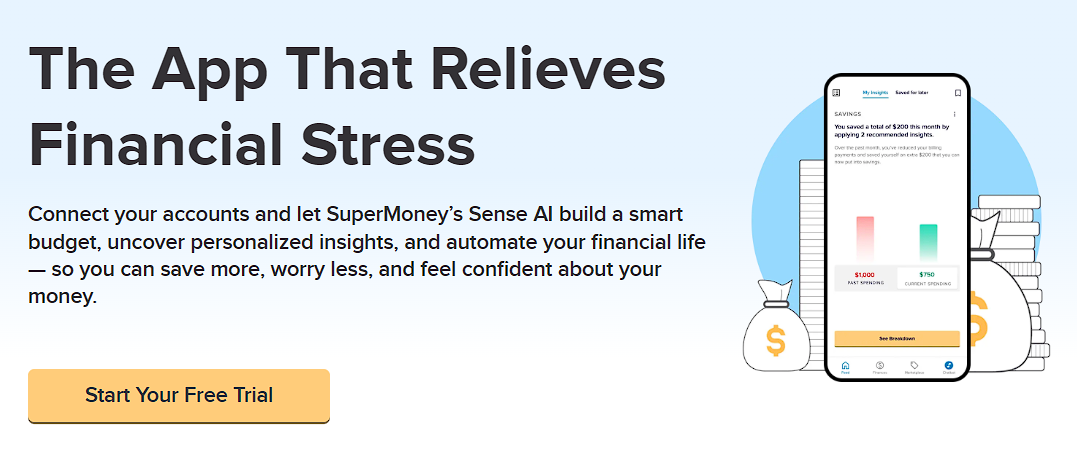
See if your savings are growing as fast as your income
The SuperMoney app tracks your net worth alongside your spending — so you can see at a glance whether income growth is building wealth or just funding a bigger lifestyle.
How to avoid lifestyle creep
The most effective prevention isn’t restriction — it’s automation. If every income increase is automatically redirected to savings before it reaches your spending accounts, it can’t be absorbed by discretionary spending.
Automate a savings increase with every raise. When your income rises, immediately increase your automatic savings transfer by at least 50% of the net increase. If a raise adds $500/month after tax, automate $250 of it to savings before you have a chance to adjust your spending to the new number. You’ll still get a lifestyle upgrade — the remaining $250 — but you’ll also build wealth from the increase rather than consuming it entirely.
This is the core principle behind the set-it-and-forget-it money system: remove spending decisions from the equation by automating the saving decision first, then spending whatever remains.
Keep your savings rate as a fixed percentage, not a fixed amount. Saving $500/month feels responsible — but if your income doubled, that $500 represents a shrinking share of what you earn. Commit to a percentage (10%, 20%, whatever your situation allows) and let the dollar amount scale with income automatically.
Introduce a deliberate upgrade review. Before making any lifestyle upgrade — a bigger apartment, a new car, a premium subscription — ask one question: Am I upgrading because this adds genuine value, or because I can now afford to? The ability to afford something is not itself a reason to buy it. The upgrade should pass the same scrutiny you’d apply if you were earning less.
Maintain visibility into your budget percentages, not just your dollar balances. A bank account that looks comfortable can mask lifestyle creep entirely if spending has scaled proportionally with income. Tracking the percentage of income going to needs, wants, and savings makes inflation in any category immediately visible.
How to reverse lifestyle creep: the spending freeze
If lifestyle creep is already underway, the most direct reset is a spending freeze — a defined period where all non-essential spending stops entirely.
A spending freeze works differently from permanent cuts. It’s a temporary, bounded experiment that surfaces which expenses you actually miss and which you simply never questioned. The typical outcome: after 30 days, roughly half the items you expected to miss don’t feel worth resuming.
How to run a 30-day spending freeze:
- Define what’s exempt. Needs continue: rent, utilities, groceries (at a reasonable budget), insurance, minimum debt payments, and any subscription essential to your work. Everything else pauses.
- Pause, don’t cancel, all discretionary subscriptions. Cancellation can wait until after the freeze. The goal is to go 30 days without using or adding anything discretionary — then evaluate each item with fresh eyes at the end.
- Find free alternatives for common wants. Dining out → cook at home. Gym → outdoor workouts or free YouTube routines. Entertainment → library, podcasts, free streaming tiers. The freeze builds awareness of how many paid defaults have free equivalents.
- Track every dollar you didn’t spend. At the end of each week, calculate the discretionary spending you avoided. Seeing the number accumulate is motivating and clarifying — most people are surprised by the total.
- At day 30, review each paused item deliberately. For each discretionary expense, ask: Did I miss this? Does it add enough value to justify the cost? Resume only the ones that clearly earn a yes. The rest either stay cancelled or go on a probationary reduced budget.
The goal isn’t permanent austerity — it’s a reset that gives you a clean baseline from which to make deliberate choices about what to add back, rather than never questioning what accumulated over time.
Redirecting the money freed by a spending freeze toward savings works best when it’s automated immediately. Automating your savings before the spending freeze ends prevents the freed-up money from simply being absorbed by new discretionary spending once the freeze lifts. The underlying goal is to permanently stop overspending as income grows — the freeze resets your baseline, but automating savings is what prevents the cycle from repeating.
Lifestyle creep vs. intentional upgrading
Not every spending increase is lifestyle creep. The distinction matters, because the goal isn’t to freeze your standard of living permanently — it’s to upgrade it deliberately rather than by default.
| Factor | Lifestyle Creep | Intentional Upgrading |
|---|---|---|
| Decision process | Gradual, unconscious, habitual | Deliberate, evaluated, chosen |
| Effect on savings rate | Savings rate stays flat or shrinks | Savings rate maintained or grows |
| Relationship to income growth | Spending absorbs all income increases | Income increases are split between saving and spending |
| Reversibility | Feels like sacrifice to reverse | Remains a choice — can be adjusted without distress |
| Long-term outcome | No wealth accumulation despite rising income | Lifestyle and net worth both improve over time |
A useful internal test: if you reduced your spending back to your previous level, would it feel like a genuine hardship or just an adjustment? Lifestyle creep produces spending that feels irreversible. Intentional upgrading produces spending you chose and could un-choose if your circumstances changed.
Concern about overcorrecting — becoming obsessed with every dollar spent after recognizing lifestyle creep — is also worth acknowledging. Obsessing over money has its own costs, and the goal is deliberate spending, not anxious restriction.
Track your savings rate automatically as your income grows
The SuperMoney app connects your accounts and tracks your net worth over time — making it easy to see whether your wealth is growing alongside your income, or whether lifestyle inflation is quietly absorbing the difference.
Key takeaways
- Lifestyle creep is the gradual process where spending rises to match income increases, leaving savings unchanged even as earnings grow.
- It’s driven by hedonic adaptation (upgrades become the new normal) and social comparison (peers’ spending becomes your reference point).
- Key warning signs: your savings rate hasn’t grown with your income, you can’t identify where extra earnings went, and a significant income drop would be financially catastrophic.
- The most effective prevention is automating savings increases with every raise — redirect at least 50% of any net income increase before it reaches your spending accounts.
- A 30-day spending freeze is the most direct reset: pause all non-essential spending, identify what you genuinely missed, and resume only those items deliberately.
- Not all spending increases are lifestyle creep. The distinction is process: lifestyle creep is unconscious and absorbs all income growth; intentional upgrading is deliberate and preserves savings rate.
What is the meaning of lifestyle creep?
Lifestyle creep — also called lifestyle inflation — is the gradual process where spending rises to match income increases, leaving savings unchanged even as earnings grow. It happens because each individual upgrade feels like a reasonable reward, but collectively they reclassify discretionary spending as baseline necessity, eliminating the margin that income growth should have created.
Is lifestyle creep a real thing?
Yes. Consumer spending data consistently shows that discretionary spending scales with income across most household categories. The pattern is well-documented in behavioral economics: as income rises, consumption rises proportionally rather than savings growing, due to hedonic adaptation and social comparison effects. Recognizing it as a real and common pattern — not a personal failure — is the starting point for addressing it.
How do I reverse lifestyle creep?
The most direct method is a 30-day spending freeze: pause all non-essential spending, identify which expenses you genuinely miss, and resume only those deliberately. Immediately automate a portion of the freed-up money to savings before the freeze ends, so it can’t be reabsorbed by discretionary spending. Then set a savings-rate target as a percentage of income rather than a fixed dollar amount, so it scales automatically with any future earnings growth.
How do I avoid lifestyle creep after a raise?
When your income increases, immediately raise your automatic savings transfer by at least 50% of the net increase before adjusting any spending. This means income growth is split: part builds wealth, part funds an intentional lifestyle upgrade. The key is automating the savings decision first, before discretionary spending expands to fill the new income.
What is the difference between lifestyle creep and lifestyle inflation?
Lifestyle creep and lifestyle inflation refer to the same phenomenon — spending rising proportionally with income. “Lifestyle creep” emphasizes the gradual, unnoticed nature of the pattern; “lifestyle inflation” is used more in economic and financial planning contexts. Both describe spending that absorbs income growth rather than allowing it to build wealth.
What are examples of lifestyle creep?
Common examples include: upgrading to a larger apartment after a raise (when the previous one was adequate), switching from cooking at home to regular restaurant meals, adding multiple streaming services that accumulate over time, trading a reliable used car for a luxury model, and shifting from economy to business-class travel. Each individual example feels reasonable — the problem is the cumulative effect on savings rate over time.
Budgeting Rules Series and Financial Ratios
- 50/30/20 Budget Rule — The most popular budgeting framework and why it’s aspirational rather than realistic in most U.S. states.
- 60/20/20 Budget Rule — A needs-heavy alternative that gives more breathing room when essential expenses eat past 50% of income.
- 70/10/20 Budget Rule — How this simplified split works for people prioritizing debt payoff alongside modest savings.
- 80/20 Budget Rule — The minimalist approach: save 20%, spend 80%, and skip granular category tracking entirely.
- Zero-Based Budgeting — Assign every dollar a job so your income minus expenses equals exactly zero each month.
- The 3% Home Improvement Rule — A guideline for capping annual renovation spending relative to your home’s value.
- 30% Rent Rule — The classic affordability benchmark and when it actually makes sense to spend more or less.
- The 5-Year Rule for Buying a Home — Why staying put at least five years is often the breakeven point where buying beats renting.
Feeling overwhelmed by money worries?
SuperMoney's AI-powered budgeting tools help you track your money goes, set realistic goals, and reduce financial stress.
Andrew is the Content Director for SuperMoney, a Certified Financial Planner®, and a Certified Personal Finance Counselor. He loves to geek out on financial data and translate it into actionable insights everyone can understand. His work is often cited by major publications and institutions, such as Forbes, U.S. News, Fox Business, SFGate, Realtor, Deloitte, and Business Insider.
Share this post:
Add as a preferred source on Google
Table of Contents