
Pros and Cons of a High-Yield Savings Account (An Honest Assessment)

Last updated 03/18/2026 by
Andrew Latham
Edited by
Andrew Latham
Summary:
A high-yield savings account is a federally insured deposit account that pays significantly more interest than a standard savings account, with no lock-in period and no penalty for withdrawals.
Whether it’s the right choice depends on what you’re saving for and how you weigh rate against flexibility.
- Main advantage: HYSA rates are often many times higher than the national average for standard savings accounts, with full FDIC protection and no commitment required.
- Main limitation: The rate is variable and can drop at any time — you’re not guaranteed today’s APY tomorrow.
- Best for: Emergency funds, short- to medium-term savings goals, and anyone keeping cash that would otherwise sit in a low-yield bank account.
- Worth it? For most people with idle cash above a checking account buffer, yes — the upside is meaningful and the downsides are manageable.
High-yield savings accounts have become one of the most talked-about personal finance tools of the past few years — and for good reason.
But “high-yield” can mean different things in different rate environments, and the accounts come with real limitations worth understanding before you move your money.
Compare Savings Accounts
Compare savings accounts. Discover your best option.
Pros of a high-yield savings account
The advantages of a high-yield savings account are concrete and well-documented. Here’s what you actually gain:
- Significantly higher interest earnings. The national average APY for standard savings accounts sits well below 1%, while competitive HYSAs — typically offered by online banks — routinely pay multiples of that. On a $10,000 balance, the difference between 0.5% and 4.5% APY is roughly $400 per year in additional interest.
- FDIC insurance up to $250,000. HYSAs at banks are insured by the FDIC — the same protection as any checking or savings account. Credit union equivalents are insured by the NCUA to the same limit. Your principal is not at risk.
- No lock-in period or early withdrawal penalty. Unlike a CD, you can withdraw from a HYSA at any time without forfeiting earned interest. This makes it suitable for emergency funds and money that may be needed on short notice.
- Compound interest on your balance. Most HYSAs compound interest daily and credit it monthly, meaning your balance earns interest on previously earned interest — a meaningful advantage on larger balances over time.
- Benefits automatically from rate increases. When the Federal Reserve raises rates, HYSA APYs typically increase alongside them, often within days. You don’t need to do anything to capture the higher rate — it applies to your existing balance.
- Low or no minimum balance requirements. Many of the most competitive HYSAs have no minimum deposit to open and no minimum balance to earn the advertised rate. Standard savings accounts at traditional banks often require higher minimums to avoid fees.
- Easy to automate. HYSAs work seamlessly with automated savings transfers — you can set recurring deposits from your checking account on any schedule without any restrictions on incoming transfers.
| Pro | What it means in practice |
|---|---|
| Higher APY | Meaningful earnings on balances you’d otherwise leave in a low-yield account |
| FDIC/NCUA insured | Principal is protected up to $250,000 — no investment risk |
| No withdrawal penalty | Full liquidity; suitable for emergency funds and flexible goals |
| Daily compounding | Interest accumulates faster on larger balances |
| Rises with rate increases | Captures Fed rate hikes automatically without any action required |
| Low minimums | Accessible regardless of balance size |
| Automation-friendly | No restrictions on incoming transfers — automate savings on any schedule |
Cons of a high-yield savings account
The limitations are real and worth taking seriously — particularly if you’re comparing a HYSA against alternatives for a specific goal.
- Variable rate — can drop without notice. The APY on a HYSA is not guaranteed. Banks can and do reduce rates when the Fed cuts or when competitive pressure eases. Factors that drive savings account rates down include Fed rate cuts, changes in a bank’s funding needs, and market competition — none of which you control.
- Interest is taxed as ordinary income. Every dollar your HYSA earns is taxable income in the year it’s credited. At higher income levels, HYSA interest is taxed at your marginal rate — potentially 22%, 24%, or higher — reducing the effective yield meaningfully. This is not a capital-gains-rate situation.
- Usually requires an online-only bank. The highest HYSA rates are almost exclusively offered by online banks and fintechs with no physical branch network. If you need in-person banking or prefer a full-service relationship, you’ll likely sacrifice some rate.
- Withdrawal limits may apply. While federal Regulation D’s six-per-month limit was suspended in 2020, many banks still enforce their own savings account withdrawal limits. Excessive withdrawals can result in fees or account conversion to a checking account at some institutions.
- Transfer delays. Moving money from a HYSA at an online bank back to your primary checking account typically takes one to three business days via ACH transfer. In a genuine emergency, “two business days away” may matter.
- Not the highest possible return. A HYSA will rarely outperform a CD at matching terms when rates are stable or falling, and it will significantly underperform equity investments over long time horizons. It is a cash management tool, not an investment.
- Rates vary significantly by institution. “High-yield” is a relative term — some banks label accounts as high-yield while paying APYs barely above the national average. The gap between the best and worst HYSAs can be 2% or more, so the label alone is not sufficient due diligence.
| Con | How significant is it |
|---|---|
| Variable rate | High — your APY can drop materially in a rate-cutting environment |
| Taxed as ordinary income | Medium-High — reduces effective yield, especially at higher tax brackets |
| Online-only for best rates | Low-Medium — inconvenience, not a financial disadvantage |
| Withdrawal limits | Low — affects frequent withdrawers; not an issue for most savers |
| ACH transfer delays | Low — a 1–3 day delay matters only in specific emergencies |
| Not an investment | Context-dependent — irrelevant if the goal is capital preservation |
| “High-yield” label varies | Medium — requires comparison shopping to find genuinely competitive rates |
Pro tip: The variable rate risk is real but manageable. Set a calendar reminder to check your HYSA’s APY every quarter against the current top rates at competitive online banks.
If your bank has fallen more than 0.5% behind the market leaders, it takes about 10 minutes to open a new account and initiate a transfer. Loyalty to a specific bank rarely pays off in the savings account category.
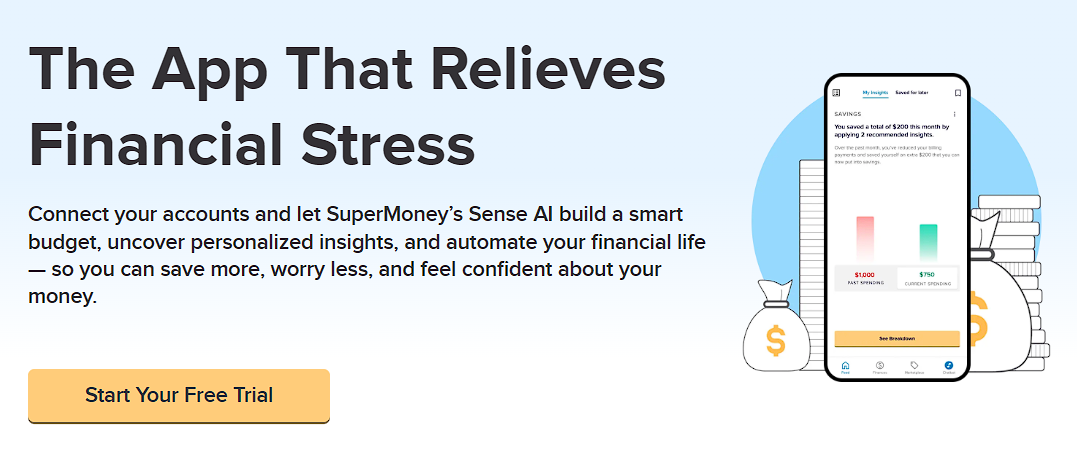 The SuperMoney app connects to your savings accounts and tracks your interest earnings automatically — so you always know your actual APY and can spot when a rate drop has made your account uncompetitive.
Is a high-yield savings account worth it?
For most people holding idle cash in a standard checking or savings account, yes — a HYSA is worth it. The effort to open one is low (typically 10–15 minutes online), the financial upside is immediate and compounding, and the downside risk is limited to a rate reduction — not a loss of principal.
The honest answer gets more nuanced based on what you’re comparing it against:
- Compared to a standard savings account: A HYSA wins almost every time. The rate differential is substantial, the accounts work identically, and you give up nothing of practical value by switching.
- Compared to a CD: It depends on whether you need access to the money and which direction rates are heading. A HYSA vs. CD comparison comes down to liquidity vs. rate certainty — neither is universally better.
- Compared to investing: For money you might need within the next one to three years, a HYSA is the right vehicle — equities carry short-term risk that cash savings don’t. For money you won’t need for five-plus years, investing will almost certainly outperform a HYSA over that horizon.
- Compared to paying down high-interest debt: If you’re carrying credit card debt at 20%+ APR, directing extra cash toward that debt delivers a guaranteed 20%+ return — no HYSA competes with that. A HYSA makes most sense once high-interest debt is eliminated or under control.
Pro tip: The tax cost of HYSA interest is worth calculating before you move large sums. At a 4.5% APY on $50,000, you’d earn roughly $2,250 in interest — taxed at your marginal rate. In the 24% bracket, that’s $540 in federal tax on that interest.
Still a net positive, but knowing the after-tax yield helps you make an accurate comparison against tax-advantaged alternatives like I-bonds or municipal money market funds.
Who benefits most from a HYSA
A HYSA delivers the most value in these specific situations:
- Emergency fund holders. Anyone keeping three to six months of expenses as a cash reserve should have it in a HYSA rather than a standard savings account. The liquidity requirement makes a CD unsuitable, and leaving emergency savings in a low-yield account is a straightforward opportunity cost.
- Short-term savers with a defined goal. Saving for a home down payment, a car, a wedding, or a similar goal over 12–36 months is exactly the HYSA use case — better return than a checking account, full liquidity until the purchase, and no penalty risk.
- People with cash above their checking account needs. If your checking account balance regularly exceeds what you spend in a given month, the excess is better positioned in a HYSA earning interest than sitting idle.
- Savers in a rising rate environment. When the Fed is hiking rates, a HYSA captures each increase automatically. This was a major advantage in 2022–2023 when rates moved from near-zero to multi-decade highs.
Who should look elsewhere
A HYSA is not the right tool for everyone in every situation. Consider alternatives if:
- You want a guaranteed rate. If your priority is locking in today’s rate before it falls — particularly with a known future date for the money — a CD is more appropriate. The HYSA’s variable rate is a meaningful disadvantage when rates are declining.
- You’re in a high tax bracket. In the 32% or 37% federal bracket, the after-tax yield on a HYSA shrinks considerably. Tax-exempt alternatives like municipal money market funds or I-bonds may offer comparable or better after-tax returns at those income levels.
- Your time horizon is five-plus years. Money you genuinely won’t need for a decade should be working harder than a HYSA can deliver. Long-duration savings belong in investment accounts — even conservative ones — not cash savings.
- You carry high-interest debt. The math on paying down 20–25% APR credit card debt is more favorable than earning 4–5% in a HYSA. Eliminating high-interest debt first is the higher-returning “investment.”
Key takeaways
- HYSAs pay significantly more than standard savings accounts with no lock-in period, no withdrawal penalty, and FDIC/NCUA insurance up to $250,000.
- The main con is a variable rate — your APY can drop when the Fed cuts or when a bank reprices its products, sometimes with little notice.
- Interest is taxed as ordinary income at your marginal federal rate, not at the lower capital gains rate — factor this into your effective yield calculation.
- For most people with idle cash above their checking account needs, a HYSA is worth it — the upside is real and the downside is limited to a rate reduction, not a loss of principal.
- HYSAs are best for emergency funds, short- to medium-term savings goals, and cash that would otherwise sit in a low-yield account.
- If you want rate certainty, consider a CD; if you want long-term growth, consider investing; if you carry high-interest debt, pay that first.
- “High-yield” is a relative label — compare APYs across institutions before opening, as rates vary significantly between banks.
Frequently asked questions
What is the downside of a high-yield savings account?
The primary downside is the variable rate — your APY is not guaranteed and will fall when the Federal Reserve cuts rates or when your bank chooses to reprice. HYSA interest is also taxed as ordinary income, which reduces the effective yield at higher income levels. Neither is a reason to avoid the account type, but both should factor into your expectations.
Is it worth putting money in a high-yield savings account?
Yes, for most people with cash sitting in a standard savings or checking account. The rate differential is real — often several percentage points on an annualized basis — and the accounts carry no investment risk or lock-in penalty. The one case where it may not be worth the switch is if you carry high-interest debt, where paying down that debt delivers a higher guaranteed return than any HYSA rate.
Are high-yield savings accounts safe?
Yes. HYSAs at FDIC-member banks are insured up to $250,000 per depositor per bank — the same protection as any checking or savings account. Your principal cannot be lost due to bank failure within that limit. Credit union equivalents carry the same protection through NCUA insurance.
Does a high-yield savings account affect your credit score?
No. Opening or closing a HYSA does not affect your credit score. Savings accounts are deposit accounts, not credit accounts — they are not reported to credit bureaus and do not appear on your credit report.
How often do high-yield savings account rates change?
Rates can change at any time and do not follow a set schedule. Banks typically adjust HYSA rates within days to weeks of a Federal Reserve rate decision. During periods of active rate movement — like the 2022–2023 hiking cycle — rates changed frequently; during stable periods, they may hold for months.
Can you lose money in a high-yield savings account?
Not in normal circumstances. HYSA balances up to $250,000 per depositor per bank are FDIC-insured, meaning even if the bank fails, your principal is protected. The one theoretical loss scenario is keeping more than $250,000 at a single bank that subsequently fails — in that case, only the insured portion would be covered.
Is a high-yield savings account better than a CD?
It depends on your timeline and rate outlook. A HYSA is better when you need flexible access to funds or when rates are rising. A CD is better when you have money you won’t need for a defined period and want to lock in the current rate before it falls. The two products solve different problems — many savers use both. A full breakdown is available in our HYSA vs. CD comparison.
Compare today’s top high-yield savings account rates on SuperMoney — filter by APY, minimum deposit, and institution to find the account that fits your balance and goals.Andrew is the Content Director for SuperMoney, a Certified Financial Planner®, and a Certified Personal Finance Counselor. He loves to geek out on financial data and translate it into actionable insights everyone can understand. His work is often cited by major publications and institutions, such as Forbes, U.S. News, Fox Business, SFGate, Realtor, Deloitte, and Business Insider.
Share this post:
Add as a preferred source on Google
Table of Contents