
Should I Pay Off Debt or Save? It Depends, and Here’s How to Decide

Last updated 10/13/2026 by
SuperMoney Team
Edited by
Andrew Latham
Summary:
Should you pay off debt or save? There’s no single right answer. It depends on your interest rates, how much cash you have on hand, whether you’re getting your full 401(k) match, and what’s coming up in your life. As a rule of thumb, high-interest debt like a 22% credit card beats a 4% savings account, but only once you have a small emergency cushion so the next surprise doesn’t go right back on the card. The best answer uses your real numbers, which is where an AI assistant that can see your accounts helps.
“Should I pay off debt or save?” is one of the most common money questions I get, and I wish I could give everyone the same answer. I can’t. Two people with the exact same $5,000 can make opposite choices and both be right.
That’s not a cop-out. It’s just how money works. The right move depends on your interest rates, how much cash you have, your job, your goals and even your habits. So instead of a one-line rule, here’s how to think it through, the math that matters most, and an example of what truly personalized advice looks like.
If you’re curious how everyone else would handle this, the Federal Reserve recently asked Americans what they’d do with an extra month’s pay. On average they’d save 47%, put 30% toward debt and spend 22%. I broke down that study in what Americans would do with a financial windfall. The average is interesting. Your answer should be personal.
Get Competing Personal Loan Offers In Minutes
Compare rates from multiple vetted lenders. Discover your lowest eligible rate.
It's quick, free and won’t hurt your credit score
Should I pay off debt or save? Start with the math
Paying off debt is a guaranteed return equal to the interest rate. Every dollar you put toward a card charging 22% “earns” you 22% by not being charged. Saving earns whatever your account pays. So the first comparison is simple: what does each choice do for you this year?
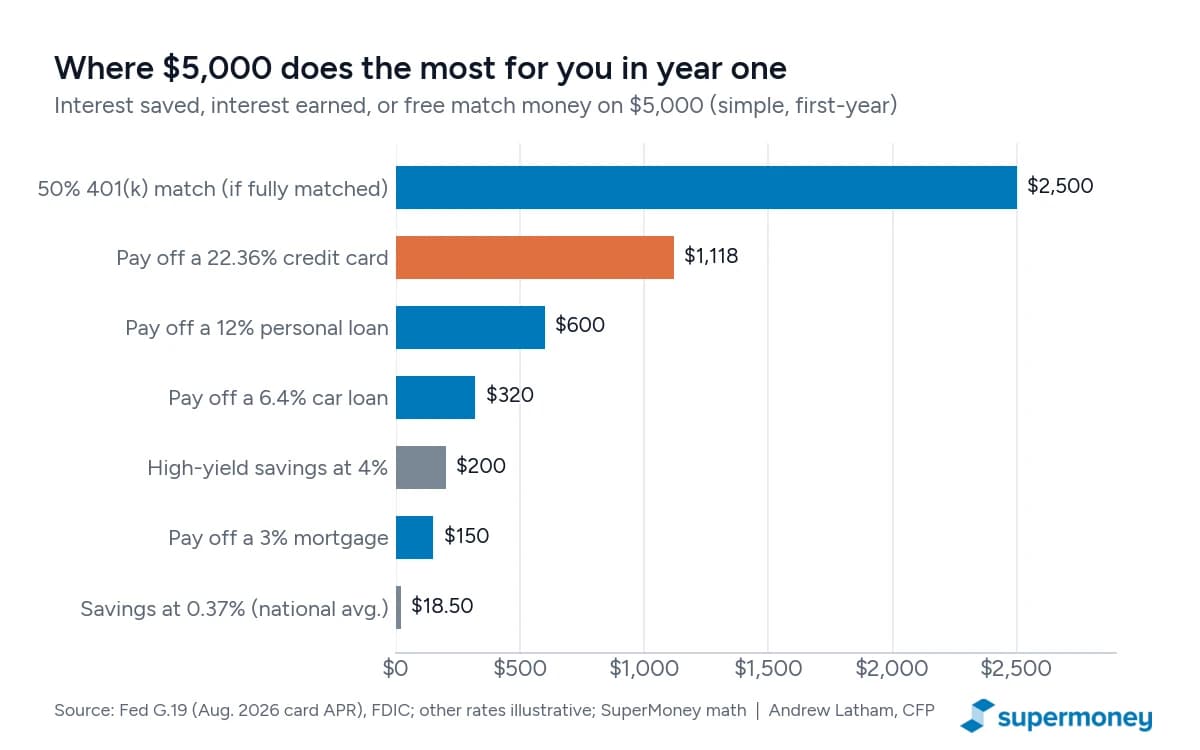
Credit card accounts that carry a balance charged an average of 22.36% in August 2026, according to the Federal Reserve. Meanwhile, the FDIC (Federal Deposit Insurance Corporation) puts the national average savings rate at just 0.37%. Top high-yield savings accounts pay a lot more, so I’ll use 4% as an illustrative rate. Here’s what $5,000 does in each spot over one year:
| Where $5,000 goes | Rate | Value in year one |
|---|---|---|
| 401(k) contributions that get a 50% match | 50% instant match | $2,500 from your employer |
| Credit card balance | 22.36% | $1,118 in interest avoided |
| Personal loan | 12% (example) | $600 in interest avoided |
| Car loan | 6.4% (example) | $320 in interest avoided |
| High-yield savings | 4% (example) | $200 earned, before taxes |
| Mortgage | 3% (example) | $150 in interest avoided |
| Average savings account | 0.37% | $18.50 earned |
These are simple first-year numbers, but the order is the point. Free match money is the best deal there is. High-interest debt comes next by a mile. Low-rate debt, like a 3% mortgage, is a weaker use of extra cash than a good savings account.
Speed matters too. Here’s the same $5,000 card balance at 22.36% paid off at three different speeds:
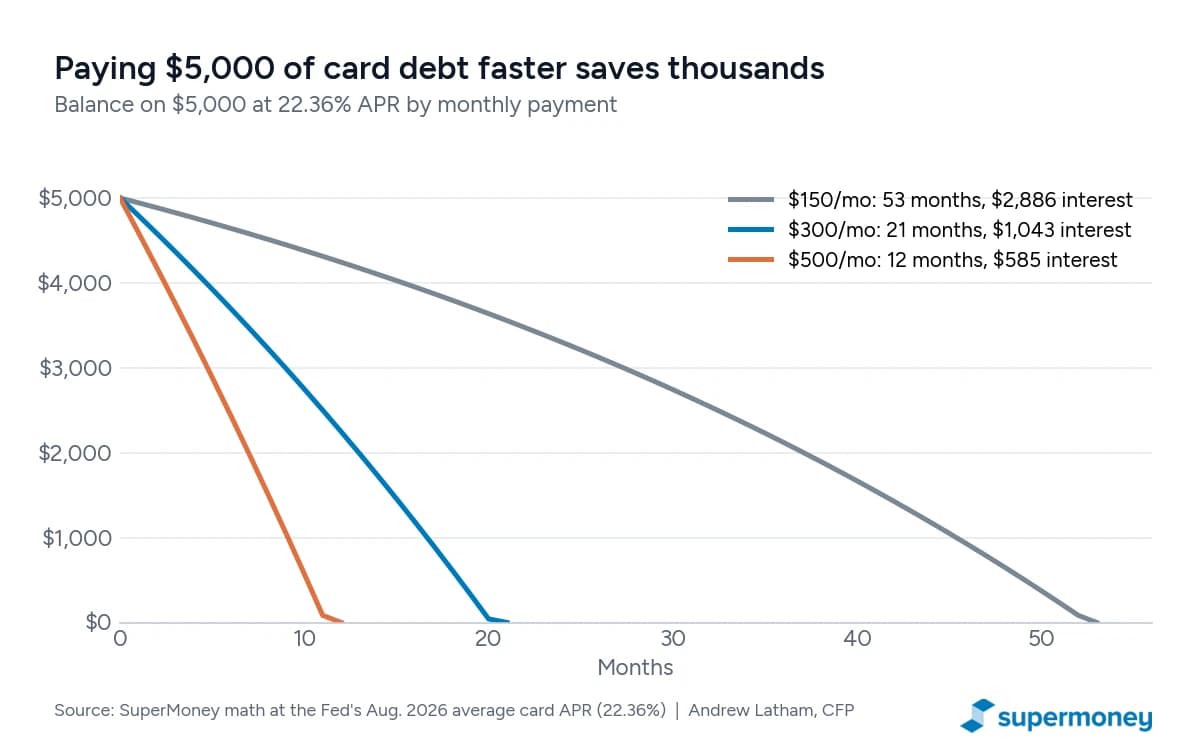
Going from $150 to $300 a month saves you about $1,840 in interest and more than two and a half years of payments. If your card only gets the minimum credit card payment, the gap is even bigger.
Why math alone isn’t the whole answer
If the math were the whole story, everyone would throw every spare dollar at their credit card. Here’s the problem: if you have no savings, the next car repair or vet bill goes right back on that card. You end up paying the card down, charging it back up, and feeling like you’re getting nowhere.
That’s why almost every good plan starts with a small cash cushion, even if you have high-interest debt. Beyond that, a few things can flip the answer:
- Your job security. If your income is variable or your industry is shaky, cash matters more. You can’t pay rent with a paid-off credit card.
- Upcoming expenses. A known bill in two months (insurance, tuition, a move) should be saved for, not paid with a card later.
- Your 401(k) match. Skipping a match to pay down debt usually loses money.
- Your habits. If a paid-off card tends to fill back up, fix the spending leak before you pour money into the balance.
- Your goals. A down payment in two years needs savings, even if you carry a low-rate student loan.
A priority order that works for most people
Here’s the order I’d start with. Treat it as a default, not a law.
| Step | What to do | Why |
|---|---|---|
| 1 | Make every minimum payment | Late fees and credit damage cost more than anything else here |
| 2 | Build a starter emergency fund (about one month of expenses) | Keeps surprises off your credit card |
| 3 | Contribute enough to get your full 401(k) match | An instant return you can’t get anywhere else |
| 4 | Pay down high-interest debt (roughly 8% and up) | A guaranteed return that beats savings and most investments |
| 5 | Grow your emergency fund to three to six months | Protects you from a job loss or big expense |
| 6 | Split extra cash between moderate-rate debt and investing | Rates around 5% to 7% are a close call |
| 7 | Pay low-rate debt on schedule | A 3% mortgage costs less than most savings accounts pay |
If you need help with step 2, here’s how to build an emergency fund step by step. For step 4, a debt snowball calculator can map out your payoff plan.
Same $5,000, four different right answers
Here’s why there’s no universal answer. Picture four people who each get $5,000 tomorrow:
| Person | Situation | A smart move for them |
|---|---|---|
| The fresh start | $400 in savings, $4,000 on a card at 24% | About $2,000 to savings, $3,000 to the card |
| The steady saver | Six months saved, $3,000 card balance, full 401(k) match | Pay off the card in full and keep the rest |
| The freelancer | Lumpy income, one month saved, 6.8% student loans | Mostly savings, because income swings are the real risk |
| The future homebuyer | No card debt, 3% car loan, buying a home in 18 months | All to savings for the down payment |
None of these is “the” answer. Each one depends on details a blog post can’t see. That’s the honest limit of general advice, mine included.
Where personalized advice makes the difference
To give someone a truly personal answer, you need their real numbers: balances, interest rates, spending patterns, upcoming bills and income. Most people don’t have all of that in their head, and a generic calculator only knows what you type in.
This is where an AI assistant trained on personal finance and connected to your accounts helps. Sense AI, the AI money assistant in the SuperMoney app, works from the accounts you link, so it can see your balances, your spending and your bills instead of guessing. Here’s a simulated conversation to show what that looks like.
Simulated conversation for illustration. The person and numbers are made up. Your answers would be based on your own linked accounts.
You: I just got a $6,000 bonus. Should I pay off my credit card or save it?
Sense AI: Nice, congrats. I looked at your linked accounts, and I wouldn’t put it all in one place. Here’s what stands out:
- Your card balance is $4,200 at 24.99%. That’s costing you about $87 a month in interest.
- Your savings is $600. At your average spending of about $4,100 a month, that’s roughly four days of expenses.
- Your car insurance renewal of $1,140 is due in December.
- The last two years, your card balance jumped after December and took months to come down.
If you send all $6,000 to the card, it’s gone. But with only $600 saved, the next surprise (or that insurance bill) goes right back on the card at 25%.
You: So what would you do?
Sense AI: Here’s a split that fits your numbers:
- $1,140 set aside for the December insurance bill, so it never touches the card.
- $2,000 to savings, bringing you to $2,600. That’s a real cushion while you finish the card.
- $2,860 to the credit card, cutting the balance to $1,340 and saving about $715 a year in interest.
Then two monthly moves. Pay $350 a month on the remaining $1,340, and it’s gone in about five months. And raise your 401(k) from 3% to 5%. Your employer matches up to 5%, so you’re leaving about $1,440 a year in free money on the table. In the 22% federal bracket, that’s roughly $94 less in take-home pay a month.
You: What about my car loan? Should I pay that down too?
Sense AI: Not yet. At 6.4%, it’s your cheapest debt, and every extra dollar there is locked up. Once the card is paid off and your savings covers about three months of expenses (around $12,300), extra car payments start to make sense, especially since 6.4% beats what a savings account pays.
You: Got it. Can we check in on this later?
Sense AI: Anytime. I’ll be looking at your latest balances, so just ask “am I on track?” and we’ll see how the card and your savings are doing.
Notice what made that advice good. It wasn’t “pay off debt” or “save first.” It split the money based on things only your accounts reveal: a bill coming in December, a pattern of holiday card spikes, and an unclaimed 401(k) match. A generic rule would have missed all three.
| The $6,000 plan | Amount | What it does |
|---|---|---|
| Car insurance fund | $1,140 | Keeps December’s bill off the card |
| Emergency savings | $2,000 | Raises the cushion from $600 to $2,600 |
| Credit card | $2,860 | Cuts the balance to $1,340 and saves about $715 a year |
| 401(k) change | 3% to 5% | Captures about $1,440 a year in employer match |
An AI assistant isn’t a replacement for your own judgment, and for big, complicated decisions a human planner is still worth talking to. But for everyday questions like this one, having something that already knows your numbers beats guessing.
Pay off debt or invest?
The same logic applies to investing. Stock returns aren’t guaranteed, while paying off a debt is. That’s why high-interest debt almost always comes first, except for the part of your 401(k) that gets matched. For debt in the 5% to 7% range, it’s a closer call that depends on your timeline and risk tolerance. Once your match is covered, here’s where the next dollar should go.
Frequently asked questions
Is it better to pay off debt or save?
For high-interest debt like credit cards, paying it down usually wins once you have a starter emergency fund of about one month of expenses. For low-rate debt like a 3% mortgage, saving in a high-yield account often comes out ahead. The right split depends on your rates, cash cushion and goals.
Should I use my emergency fund to pay off debt?
Usually not all of it. If you drain your savings to pay a card, the next emergency tends to land back on the card. Keep at least one month of expenses, then put extra savings toward high-interest debt.
Should I pay off my credit card or save my bonus?
Often both. A common approach is to cover any known upcoming bills, top up savings to about one month of expenses, and send the rest to the card with the highest interest rate.
How much should I have in savings before paying off debt?
A starter cushion of about one month of expenses is a reasonable first goal. After high-interest debt is gone, build toward three to six months.
Should I pay off debt or invest?
Get your full 401(k) match first, then pay off high-interest debt. For moderate-rate debt around 5% to 7%, splitting extra money between paying it down and investing is a reasonable middle ground.
Key takeaways
- There’s no single right answer to “pay off debt or save.” It depends on your rates, cash cushion, job, upcoming bills and goals.
- Paying off a 22.36% credit card saves about $1,118 a year on $5,000, versus about $200 earned in a 4% savings account.
- Build a starter emergency fund first so surprises don’t go back on the card.
- Always grab your full 401(k) match before paying extra on debt.
- Personalized advice based on your real accounts beats any one-size rule.
Share this post:
Add as a preferred source on Google
Table of Contents