
The Roth conversion trap: why “tax-free” is the most expensive word in retirement planning

Last updated 10/27/2026 by
SuperMoney Team
Edited by
Andrew Latham
Summary:
A Roth conversion isn’t free money later. It’s a tax bill now. The converted amount counts as income in the year you convert, which can push you into a higher bracket, raise your Medicare premiums two years later, and make more of your Social Security taxable. Research in the Journal of Financial Planning found that a common conversion scenario may not pay for itself within a retiree’s lifetime. There’s no one-size-fits-all answer, so run your own numbers before you convert.
Roth conversions are the hottest topic in retirement planning right now. They are also, by the numbers, something almost nobody actually does.
The Investment Company Institute (ICI), the fund industry’s trade group, counted 1.6 million Roth conversions in 2023 using the latest IRS data, totaling $36.7 billion, out of roughly $16 trillion sitting in traditional IRAs. The average conversion was just under $23,000.
Fidelity told MarketWatch columnist Beth Pinsker that just 2 percent of its roughly 20 million IRA customers made a conversion in 2025. Everyone is talking about it. Almost no one is doing it.
There is a reason for that gap, and it is not laziness. It is the bill.
Compare Investment Advisors
Compare the services, fees, and features of the leading investment advisors. Find the best firm for your portfolio.
The doorway is where the money changes hands
Take a hypothetical couple, both 64, retired, with $900,000 in traditional IRAs and no pension income yet. They have heard that Roth money is tax-free forever, with no required minimum distributions during their lifetimes, and they want to move fast before those distributions start at 75.
So they convert $150,000 in a single year. Here is what happens next, in order.
First, the tax bill. A conversion is not a rollover. Moving money from a 401(k) into a traditional IRA keeps the tax deferred.
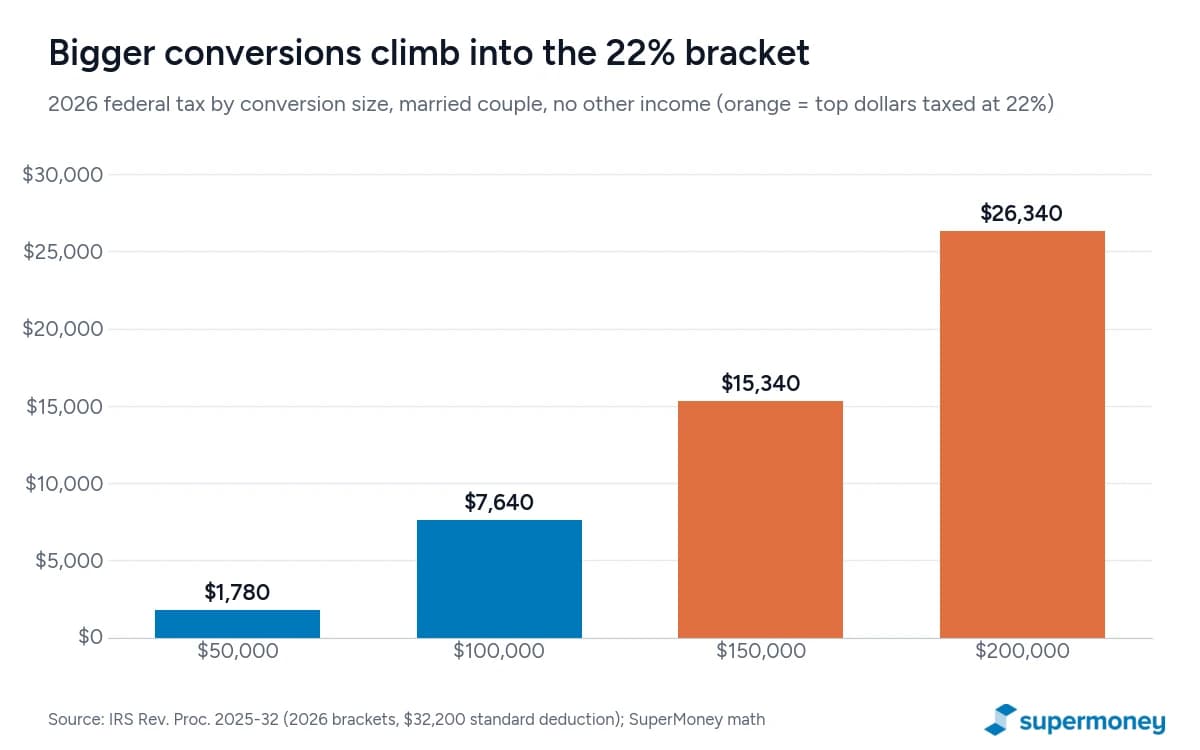
Converting pretax money into a Roth makes the converted amount taxable income in the year of conversion. At 2026 married filing jointly rates, the 12 percent bracket tops out at $100,800 of taxable income and the 22 percent bracket runs to $211,400.
A $150,000 conversion on top of their other income does not sit neatly in one low bracket. It climbs through them, and the top slice gets taxed at a rate far above what they imagined when they heard the words “tax-free.”
Second, the Medicare bill, which arrives two years late. Medicare premiums are set by income from two years earlier.
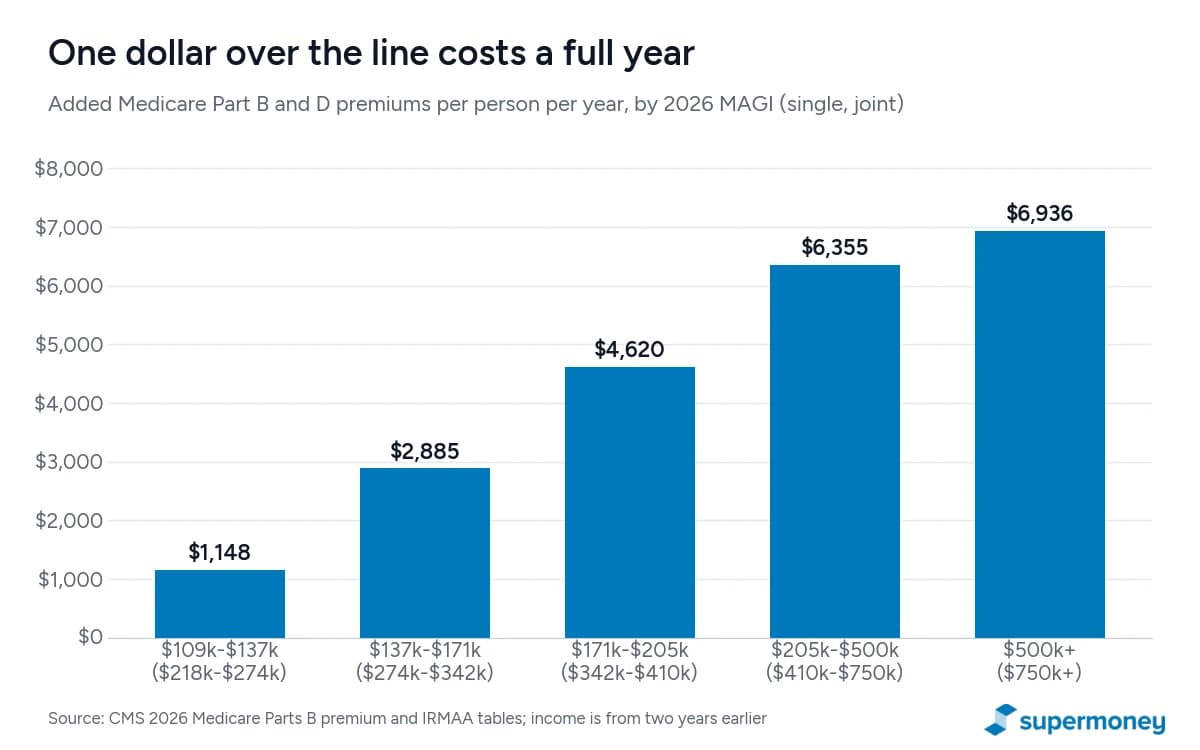
For 2026, the standard Part B premium is $202.90 a month, and surcharges begin once modified adjusted gross income passes $109,000 for a single filer or $218,000 for a couple. Cross that first line by a single dollar and a single filer pays $1,148.40 more over the year in Part B and Part D surcharges combined. For a couple with both spouses on Medicare, roughly double it.
Our couple’s $150,000 conversion alone stays under the $218,000 joint line, so the surcharge only hits if their other income that year, such as IRA withdrawals, part-time pay or investment gains, tops about $68,000. The accounting firm SDO CPA tells clients to budget an extra $2,000 to $8,000 or more a year in Medicare costs for a large conversion.
And the timing is cruel: convert at 63 and the income spike lands exactly in the year you first enroll in Medicare at 65.
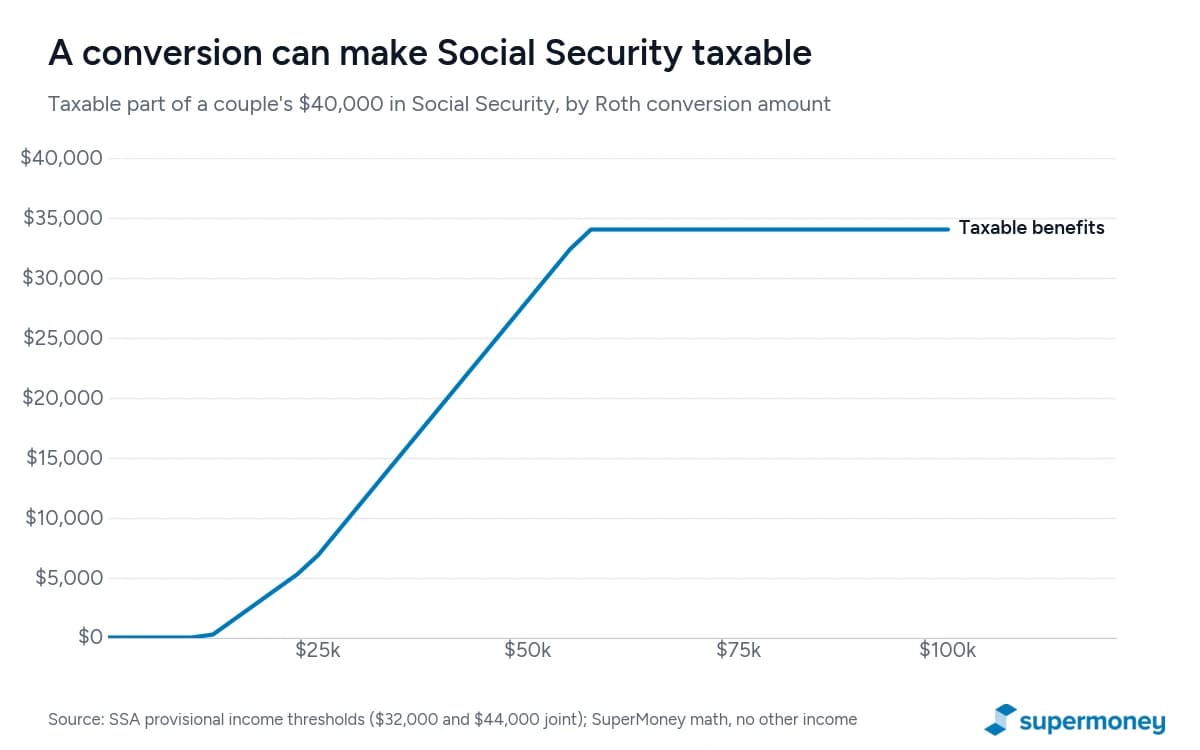
Third, the Social Security bill, which arrives the same year. A conversion counts toward provisional income, which is adjusted gross income plus nontaxable interest plus half of Social Security benefits.
Between $25,000 and $34,000 for a single filer, or $32,000 and $44,000 for a couple, up to half of benefits can be taxable. Above those ceilings, up to 85 percent can be taxable. One conversion can push a client over a line they did not know existed and make more of their Social Security check taxable in the same year.
None of this is an argument against Roth conversions. It is an argument against doing them in one big, unexamined move.
The study that should slow everyone down
The most useful corrective comes from Edward McQuarrie, professor emeritus at Santa Clara University, in a net present value analysis published in the Journal of Financial Planning.
He took a hypothetical 72-year-old converting $100,000, paying 22 percent now, versus paying 25 percent later on required distributions. A three-point rate advantage sounds like an obvious win. Discounted properly, it is not.
McQuarrie found the cumulative tax savings would likely not pass the upfront tax bill until after the retiree’s expected death, and would still fall about $7,000 short at life expectancy.
And that 25 percent assumed the 2017 tax cuts would expire. Congress made those rates permanent in 2025, which makes the math even harder.
That does not mean conversions never pay. It means the payoff is a bet on three things at once: that future tax rates will be higher, that the client will live long enough for the savings to compound past the upfront cost, and that the conversion itself does not trigger side effects that eat the gain. Most conversion pitches only talk about the first bet.
There is a fourth bet hiding inside the third. When one spouse dies, the survivor files as a single taxpayer, and the brackets compress overnight. Income that fit comfortably in joint brackets can land in higher single brackets. That survivor’s bracket is often the real reason a conversion done years earlier pays off, or the reason it needed to be bigger than anyone modeled.
What the good version looks like
The planners who do this well treat a conversion as a multi-year project, not an event. The shape of it is consistent.
Start with the bracket, not the balance. The prime window is usually the years between retirement and required minimum distributions, when earned income is gone and Social Security may not have started.
In those years, fill a target bracket and stop. An illustration from the planning firm Summit Investments & Financial Planning makes the point cleanly. Take a 60-year-old with $500,000 in a traditional IRA growing 7 percent a year:
| Plan | Total converted | Tax paid | Projected lifetime savings |
|---|---|---|---|
| $50,000 a year for 5 years (stays in 22%) | $250,000 | $55,000 | About $48,000 |
| $100,000 a year for 3 years (spills into 24%) | $300,000 | $69,000 | About $38,000 |
Savings are measured against doing nothing. Neither plan empties the IRA, and the rest keeps growing as pretax money. The faster plan moves more money and still saves less. Smaller slices, kept inside a bracket, beat bigger slices that spill over it.
Pay the tax from outside the account. If the tax comes out of the converted money itself, the account you were trying to grow tax-free shrinks on day one. Pinsker’s column on the conversion gap names this as one of the three real barriers, alongside knowing the conversion will actually pay and knowing how to execute it. Clients without cash on hand for the bill should convert less, or wait.
Watch the calendar, not just the bracket. A conversion at 63 or 64 shows up in Medicare premiums at 65 or 66. A conversion in any year shows up in that year’s Social Security taxation. Model both before signing off, and remember the IRMAA cliffs: one dollar over a threshold buys a full year at the higher premium.
And do not confuse a rollover with a conversion when a client leaves a job. Rolling a 401(k) into a traditional IRA means more investment choices and simpler consolidation, with no tax on the move itself. The tax bill only arrives when money is converted to Roth or withdrawn.
The line for the client conversation
Clients hear “tax-free” and stop listening. The planner’s job is to keep them listening through the part about the bill that comes first, because that bill is the whole decision.
A Roth conversion is not a product to buy. It is a tax payment made early, on purpose, in the hope that the future rate will be worse. Sometimes that hope is well founded. Sometimes, as McQuarrie’s math shows, it is not even enough. The clients who benefit are the ones whose conversions are sliced to fit a bracket, paid from outside cash, timed around Medicare’s two-year lookback, and sized for the survivor’s tax bracket as well as their own.
Everyone else is just prepaying a tax bill they did not need to pay yet, and calling it planning.
There’s no one-size-fits-all answer
Whether a conversion makes sense depends on your income this year, your income later, your health, your spouse, and where the cash for the tax bill comes from. Two people with the same IRA balance can get opposite answers.
Start by testing your own numbers. You can try SuperMoney free with a trial, link your accounts, and ask Sense™, our AI money coach, to walk you through what to look for: which bracket you’re in, how close you are to a Medicare surcharge line, and how much cash you’d need to pay the tax from outside the account. It’s education, not a sales pitch, and it’s built around your real numbers.

If you’re still not sure after that, talk to a fee-based financial advisor who specializes in retirement income and tax planning. It isn’t easy, but it isn’t rocket science either. Once you see your numbers laid out, you may find you can do it yourself.
Key takeaways
- A Roth conversion is taxed as income in the year you convert. For a married couple with no other income in 2026, converting $150,000 costs about $15,340 in federal tax.
- Medicare premiums use income from two years earlier. Going $1 over $109,000 single ($218,000 joint) adds $1,148.40 per person for the year.
- Conversion income counts toward provisional income, so it can make up to 85% of Social Security benefits taxable.
- A Journal of Financial Planning study found a $100,000 conversion at 22% versus 25% later fell about $7,000 short of breaking even at life expectancy.
- Convert in slices that fit inside a bracket, pay the tax with outside cash, and plan around the Medicare lookback and a surviving spouse’s single brackets.
- There’s no one-size-fits-all answer. Test your numbers, then get help only if you need it.
Share this post:
Add as a preferred source on Google
Table of Contents