
Retiring With a Pension and 401(k)? A 1% Advisory Fee Could Cost You $220,000

Last updated 11/05/2026 by
SuperMoney Team
Edited by
Andrew Latham
Summary:
If you’re retiring with a pension and a 401(k), the most expensive advice may be the advice you pay for every year. On a $400,000 nest egg, a 1% advisory fee costs $4,200 in year one and could leave you about $220,000 poorer by age 90, compared with low-cost index funds and roughly $1,000 of hourly advice. The research points to a better path: learn the basics first, get organized, then pay an hourly financial advisor who is a fee-only fiduciary to check the few decisions you can’t undo.
A reader wrote to MarketWatch this month with a question I hear all the time. They’re retiring in November with a pension and a 401(k), and they want someone to “help me and teach me the basics of investing so that my money will grow.” When MarketWatch asked me, my answer was simple: hire an hourly financial advisor for a few hours, not a money manager for the rest of your life.
That answer surprises people. Isn’t more help better? Not when the help costs 1% of your savings every year, and not when the person giving it gets paid more for steering you into certain products. Here’s what the best research says about this exact moment, and a four-step plan that puts you in charge.
Compare Investment Advisors
Compare the services, fees, and features of the leading investment advisors. Find the best firm for your portfolio.
Three retirement decisions you can’t undo
Most money decisions can be fixed later. A few can’t, and they all land in the months around your last paycheck.
1. When you claim Social Security
If your full retirement age is 67 (anyone born in 1960 or later), claiming at 62 permanently cuts your check to 70% of your full benefit. Waiting until 70 raises it to 124%. On a $2,000 full benefit, that’s $1,400 a month versus $2,480 a month, a difference of $12,960 a year for as long as you live, plus cost-of-living raises on the bigger number.
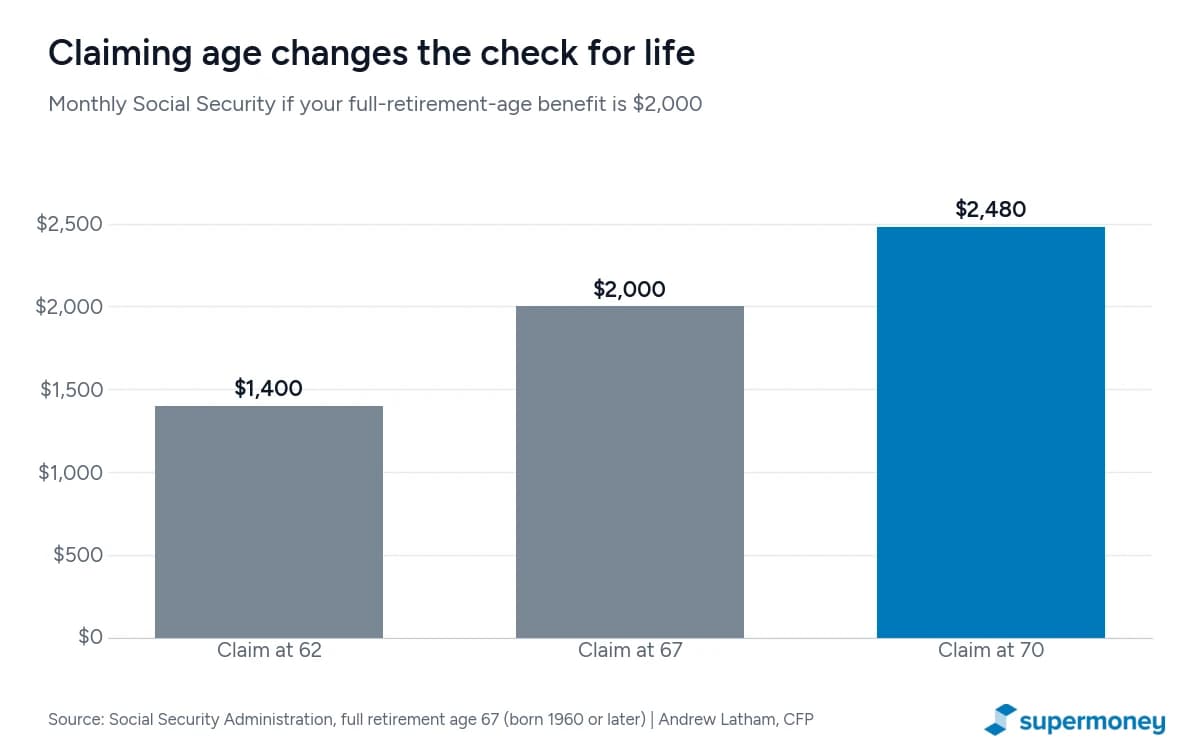
Economists David Altig, Laurence Kotlikoff and Victor Yifan Ye studied this for the National Bureau of Economic Research (NBER), a nonprofit research group. They found more than 90% of workers aged 45 to 62 should wait until 70, but only about 10% appear to. The median household gives up $182,370 in lifetime spending by claiming too early. For most people, this is the single biggest lever they have.
But “most people” isn’t you. That study looks at averages, and you’re an individual. Waiting from 62 to 70 means skipping eight years of checks, about $134,400 in our example, and the bigger check takes roughly 10 years to make that up. So waiting only pays off if you live past about 80. Here’s when claiming earlier can be the smarter call:
- Your health is poor or your family history is short. If a serious diagnosis makes 80 unlikely, the bigger check may never catch up.
- You’re the lower earner in a married couple. When one spouse dies, the survivor keeps the larger of the two checks. That makes it important for the higher earner to wait, but the lower earner can often claim earlier with little long-term cost.
- Waiting would drain your savings too fast. Delaying works when you have savings or a pension to live on in the meantime. If covering eight years would empty your 401(k) or push you into credit card debt, a smaller check now can be the safer choice.
- You have a child under 18 at home. Once you claim, a minor child can collect a benefit of their own, which can add real money to the household.
The right age depends on your health, your marriage and your cash. That’s exactly why it’s worth running your own numbers, not following a rule of thumb.
2. Monthly pension or lump sum
Many pensions let you take a lifetime monthly check or a one-time lump sum. As one planner told MarketWatch, your pension “may not need to be rolled over” at all. A monthly check that lasts as long as you do is valuable insurance against outliving your money, and the survivor option you pick for a spouse is usually permanent too.
3. Where your 401(k) goes
Rolling a 401(k) into an IRA (individual retirement account) is when a lot of people meet a salesperson. The White House Council of Economic Advisers, the president’s in-house economists, estimated in 2015 that conflicted advice cost savers about 1 percentage point a year, roughly $17 billion annually. For a retiree who rolled over $100,000 and got conflicted advice, they estimated a loss of about 12% of savings over time, as if $12,000 vanished in the transfer.
Why “find someone to teach me” can backfire
Asking an adviser to teach you is a great instinct. The problem is that some advisers earn more when you don’t learn much.
In a famous audit study, researchers Sendhil Mullainathan, Markus Nöth and Antoinette Schoar sent trained shoppers posing as regular clients to financial advisers in Boston and New York. Advisers often failed to correct clients’ mistakes and sometimes made them worse when it helped the adviser. They pushed actively managed funds with higher fees, even to shoppers who walked in with a cheap, diversified portfolio. The less informed a client seemed, the worse the advice.
And most of us walk in less informed than we think. The 2025 TIAA Institute-GFLEC Personal Finance Index, a yearly test of everyday money knowledge, found U.S. adults answer only 49% of its questions correctly. Questions about risk scored lowest, at 36%.
That gap shows up in what gets sold. U.S. annuity sales hit $464.1 billion in 2025, according to LIMRA, the insurance industry’s research group, and fixed indexed annuities set a sales record at $127.9 billion. Some annuities are useful. But one planner warned the MarketWatch reader that when retirees ask for “high-yielding investments,” many advisers “reach for an annuity.” If you already have a pension, you may already own the most important annuity you’ll ever need.
Hourly financial advisor vs. a 1% fee: what it costs a new retiree
The standard way advisers charge is a percentage of assets under management (AUM), usually around 1% a year. Kitces Research, which surveys hundreds of financial planners, found median fees of 1% on portfolios up to $1 million. The same research found a median hourly rate of $250 and a median standalone financial plan of $2,500.
Here’s what that difference looks like on a $400,000 401(k). I assumed a 6% gross return, $16,000 in withdrawals the first year, rising 2.5% a year to keep up with inflation, and 0.05% fund costs in both cases. One retiree pays a 1% advisory fee. The other pays about $1,000 once for four hours of hourly advice.
| $400,000 at 65, through age 90 | 1% advisory fee | Hourly advice + index funds |
|---|---|---|
| Fee in year one | $4,000 advisory fee + $200 fund costs | $1,000 once + $200 fund costs |
| Balance at 75 | $425,722 | $478,219 |
| Total costs over 25 years (fees + fund costs) | $108,278 | $7,156 |
| Balance at 90 | $363,928 | $585,083 |
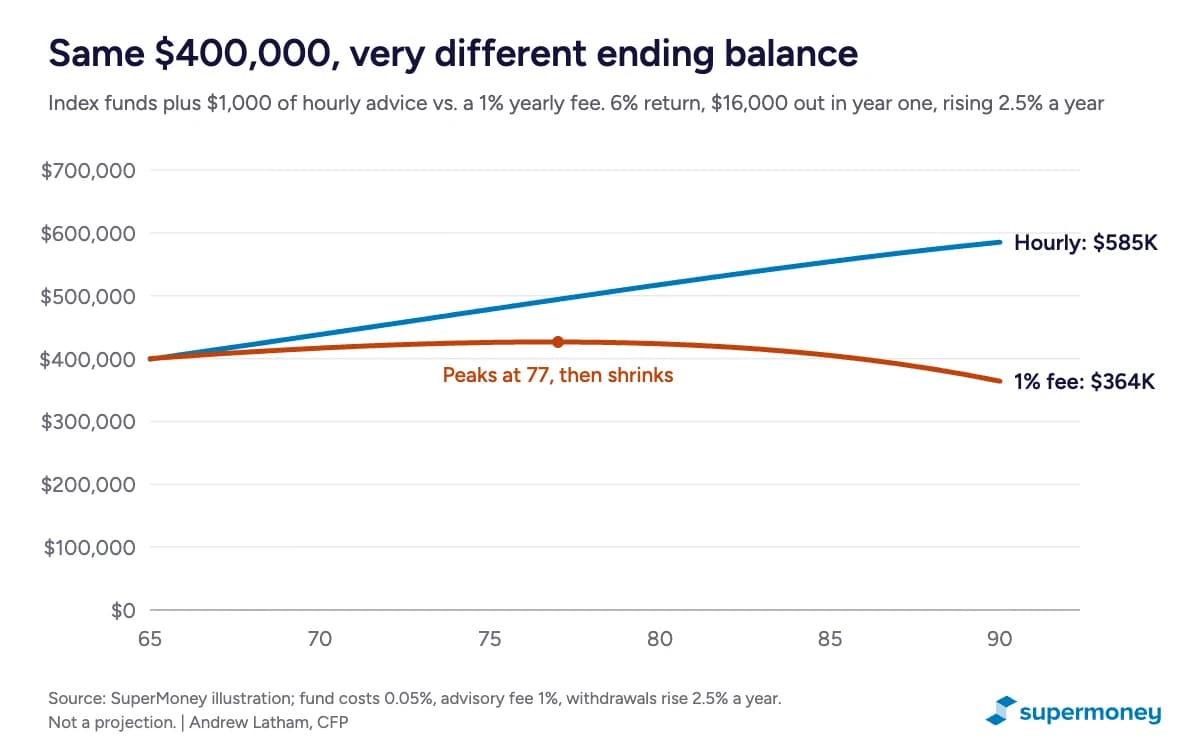
That’s a gap of about $220,000. The hourly retiree’s balance keeps growing the whole time. The 1% retiree’s peaks at 77, then starts shrinking as rising withdrawals and the fee outpace growth. Real markets won’t hand you a smooth 6% a year, so treat this as an illustration, not a forecast. The point holds either way: a fee charged on your whole balance, every year, compounds against you the same way returns compound for you.
What a good adviser is actually worth
To be fair, advisers can earn their fee. Vanguard’s long-running Advisor’s Alpha research says behavioral coaching alone, talking clients out of panic selling and performance chasing, may add up to 2% a year in net returns. That value is lumpy. It shows up mostly in scary markets, not every year.
Morningstar’s Mind the Gap study shows why coaching matters. Over the 10 years through 2024, the average dollar in U.S. mutual funds and ETFs earned 7.0% a year, while the funds themselves returned 8.2%. Investors lost 1.2 points a year to bad timing. But investors in all-in-one allocation funds, the category that includes target-date funds, captured the largest share of their funds’ returns.
So the value of an adviser is mostly behavioral, and a simple, automatic portfolio gets you much of the same benefit for free. If you know you’ll panic and sell in a crash, ongoing advice may be worth paying for. If you can set up a simple plan and leave it alone, you probably don’t need to pay 1% a year for it.
How much can you safely spend?
Morningstar’s 2025 retirement income research puts the highest safe starting withdrawal rate at 3.9% for retirees who want steady, inflation-adjusted spending over 30 years. On $400,000, that’s about $15,600 in year one. Morningstar also found that flexible spending rules work better when you have a large, predictable income floor.
That’s the good news for a retiree with a pension. If your pension plus Social Security covers your basic bills, your 401(k) doesn’t have to pay the rent. It can stay invested for growth and pay for travel, home repairs and the things that make retirement fun.
A four-step plan: learn, organize, then pay for a few hours of advice
Step 1: Write down your income floor
Add up your monthly pension (under each payout option it offers), your estimated Social Security at 62, 67 and 70 from your my Social Security account, and your basic monthly bills. If the floor covers the bills, you’re in a strong position before you’ve invested a dollar. If you’ve changed jobs over the years, also make sure you’ve tracked down every old 401(k) before you add it all up.
Step 2: Get organized and learn the basics with SuperMoney
The questions an adviser will ask are the questions you should be able to answer first: what you own, what you owe, what you spend and what you want the money to do. You can try the SuperMoney app free, link your accounts, and see your net worth and spending in one place. From there, the app gives you personalized insights drawn from your own accounts, like where your spending is drifting, what your debt is costing you and how your credit score is moving, so you start from your real numbers instead of a rule of thumb. Then ask Sense™, our AI money coach, the questions you’d feel awkward asking a salesperson: what’s the difference between an account and an investment, how a lump sum compares with a monthly pension, or how taxes work on 401(k) withdrawals.
It’s education, not a sales pitch, and every answer is built around your real numbers. You’ll walk into the adviser meeting knowing which questions matter, which, based on the audit study above, is exactly when you get better advice.
A caution on AI: a 2026 Gallup survey with Edward Jones found 18% of Americans who sought financial guidance used AI tools, but only 3% have a great deal of confidence in AI for money advice. That instinct is right. Use AI to learn and get organized, then have a human fiduciary check the decisions you can’t undo.
Step 3: Hire an hourly, fee-only fiduciary
A fiduciary is legally required to put your interests first. “Fee-only” means you pay them directly and they don’t earn commissions on products. NAPFA (the National Association of Personal Financial Advisors) and the Garrett Planning Network list advisers who work by the hour. Big-name rankings won’t tell you this, as our look at what CNBC’s top 100 advisors list misses explains, so ask every candidate how they’re paid.
You probably don’t need a full $2,500 to $5,000 financial plan. Send a one-page summary from Step 2 and ask for one deliverable: a retirement investment plan that fits your risk tolerance, uses low-fee index funds, and covers your Social Security timing and pension payout choice. At a $250 median hourly rate, two to four hours costs $500 to $1,000.
Step 4: Keep it simple and automatic
Keep one to two years of the withdrawals you’ll need from your 401(k) in a high-yield savings account or CDs, so a bad market year doesn’t force you to sell stocks low. Put the rest in a diversified, low-cost mix and leave it alone. Check in once a year, or pay for one more hour when life changes.
Frequently asked questions
How much does an hourly financial advisor cost?
Kitces Research found a median of about $250 an hour, and MarketWatch reports hourly planners typically charge $200 to $500. Most retirees with a pension and a 401(k) can get a solid plan in two to four hours.
Should I roll my pension into investments?
Not automatically. A monthly pension is guaranteed income for life, which protects you if you live a long time or markets fall early in retirement. Compare the lump sum against the lifetime income it replaces, and have a fee-only fiduciary check the math before you sign.
Is a 1% advisory fee worth it?
It can be if you need ongoing coaching to avoid panic selling or have a complicated situation. For a retiree whose pension and Social Security cover the basics, a one-time hourly plan plus low-cost index funds usually leaves far more money for you and your heirs.
What’s the difference between fee-only and fee-based advisers?
Fee-only advisers are paid only by you. Fee-based advisers charge you fees and can also earn commissions on products like annuities or insurance. The names sound alike, so ask directly how they’re paid.
Key takeaways
- On a $400,000 nest egg, a 1% yearly fee could cost about $220,000 by age 90 compared with index funds and about $1,000 of hourly advice.
- Over 90% of workers should wait until 70 to claim Social Security, but only about 10% do, costing a median $182,370 in lifetime spending. Poor health, being the lower earner in a couple, or not having enough savings to wait can make claiming earlier the better choice.
- Advisers in an audit study pushed higher-fee funds, and gave the worst advice to clients who seemed least informed.
- Learn the basics and get organized first, then hire an hourly, fee-only fiduciary to check the decisions you can’t undo.
Share this post:
Add as a preferred source on Google
Table of Contents