
The No-Spend Challenge: Rules, Tips, and a 30-Day Starter Plan

Last updated 03/04/2026 by
Andrew Latham
Edited by
Andrew Latham
Summary:
A no-spend challenge is a set period, typically 30 days, where you commit to spending money only on essentials like rent, groceries, utilities, and debt payments while cutting all discretionary purchases. Most participants save between $300 and $750 in a single month, depending on their normal spending habits and how strictly they define “essential.”
Every other savings method asks you to put money somewhere — a savings account, an envelope, a challenge tracker. The no-spend challenge works in the opposite direction: instead of adding deposits, you eliminate withdrawals.
That shift in framing matters. When saving $192 per week toward a $10,000 annual goal feels impossible, stopping $15 in daily discretionary spending feels concrete and immediate.
Compare Savings Accounts
Compare savings accounts. Discover your best option.
What Is a No-Spend Challenge?
A no-spend challenge is a voluntary financial reset where you stop all nonessential spending for a defined period. You continue paying for necessities — housing, utilities, groceries, transportation, insurance, debt payments — but pause everything else.
The challenge can last a weekend, a week, or a full month. The 30-day version is the most common because it’s long enough to break habitual spending patterns but short enough to feel achievable.
Unlike deposit-based challenges like the 100 envelope challenge or the 52-week savings challenge, a no-spend challenge doesn’t require you to find extra money. It works with whatever income you already have by redirecting what you’d normally spend on wants toward savings or debt payoff.
The Rules: What Counts as “Essential”
The biggest reason people quit a no-spend challenge early isn’t willpower — it’s ambiguity. When you haven’t decided in advance what counts as essential, every purchase becomes a negotiation with yourself. Setting clear rules before day one eliminates that friction.
How to Set Your No-Spend Challenge Rules
Define your rules in writing before day one. Post them somewhere visible — on the fridge, in your phone’s notes, or taped to your debit card.
- List your essential categories. These are non-negotiable: rent/mortgage, utilities, groceries, gas or transit, insurance premiums, minimum debt payments, medical expenses, and childcare. These get paid as normal.
- List your banned categories. Common ones include dining out, takeout coffee, online shopping, entertainment subscriptions you can pause, clothing, home décor, alcohol, and impulse purchases of any kind.
- Decide on your gray areas in advance. Will you allow gift card spending? Can you buy a birthday gift for someone? What about a work lunch you can’t avoid? Write your answer down now — not when you’re standing in line rationalizing the purchase.
- Set your timeline. A full 30 days is the standard, but a 7-day or 14-day challenge still builds the habit. Start with what feels uncomfortable but not impossible.
- Choose where the saved money goes. Open a separate high-yield savings account or designate a specific goal — emergency fund, debt payoff, or a sinking fund. Money without a destination gets reabsorbed into spending.
Essential vs. Nonessential: A Quick-Reference Table
| Category | Essential (Keep Paying) | Nonessential (Pause for 30 Days) |
|---|---|---|
| Food | Groceries, basic ingredients | Restaurants, takeout, delivery apps, coffee shops |
| Housing | Rent/mortgage, utilities, internet | Home décor, furniture, upgrades |
| Transportation | Gas, transit pass, car insurance | Uber/Lyft for convenience, car washes |
| Health | Prescriptions, doctor copays, gym membership | Supplements you don’t take, spa visits, boutique fitness classes |
| Entertainment | — | Streaming you can pause, concerts, movies, gaming purchases |
| Personal | Hygiene essentials, haircut (if needed) | Clothing, accessories, beauty products, books |
| Social | Pre-committed events (weddings, etc.) | Bar tabs, group dinners, casual meetups at restaurants |
The goal isn’t deprivation — it’s awareness. You’re not punishing yourself for spending. You’re pausing long enough to see which purchases are habits and which are choices.
How Much Can You Realistically Save?
The average American household spends roughly $1,050 per month on nonessential categories including dining out, entertainment, apparel, and personal care, according to the Bureau of Labor Statistics Consumer Expenditure Survey.
Not all of that spending disappears during a no-spend challenge — some “wants” spending still happens (a birthday gift you can’t skip, a work event). Realistic savings for a 30-day challenge typically fall between $300 and $750, depending on your baseline discretionary spending.
| Your Normal Monthly Discretionary Spending | Estimated 30-Day No-Spend Savings | Annualized (If Repeated Quarterly) |
|---|---|---|
| $500/month | $300–$400 | $1,200–$1,600 |
| $800/month | $450–$600 | $1,800–$2,400 |
| $1,200/month | $650–$900 | $2,600–$3,600 |
| $2,000+/month | $1,000–$1,500 | $4,000–$6,000 |
Those numbers compound fast. Running a no-spend challenge once per quarter — January, April, July, October — saves $1,200–$3,600 annually without changing your income at all.
A 30-Day No-Spend Plan (Week by Week)
A full month of no spending breaks down into four distinct phases. Each week tests a different part of the habit cycle.
Week 1: The Awareness Phase (Days 1–7)
The first week is the hardest because your routines haven’t adjusted yet. You’ll reach for your phone to order food, open Amazon out of boredom, or automatically pull into a coffee drive-through.
This is the week where you learn what you spend on autopilot. Write down every urge to buy something — not to shame yourself, but to build a record of your spending triggers. By day 7, you’ll have a clear list of the habits that cost you the most.
Week 2: The Substitution Phase (Days 8–14)
Awareness fades without action. Week two is about replacing spending habits with free alternatives. Cook the restaurant meals at home. Meet friends for walks instead of brunch. Use the library instead of buying books. Dig into your pantry instead of grabbing takeout.
This is also when social pressure peaks. Friends invite you to dinner. A sale email hits your inbox. The 30-day rule for impulse purchases helps here — add anything you want to a wish list and revisit it after the challenge ends.
Week 3: The Momentum Phase (Days 15–21)
By the third week, something shifts. The urges are still there, but they’re quieter. You’ve already proven you can cook at home, entertain yourself for free, and say no to convenience spending. The discomfort is replaced by a low-level sense of control.
Check your savings progress at the halfway point. Seeing $300+ accumulate from money you would have spent is the strongest motivator to finish.
Week 4: The Finish Phase (Days 22–30)
The final stretch is where the real lesson lands: most of what you cut didn’t make your life worse. Some of it made your life better — more home-cooked meals, more free activities, less decision fatigue from constant purchasing.
Before the challenge ends, decide which spending habits you’re resuming and which you’re dropping permanently. This transition plan is what separates a temporary diet from a lasting change.
Pro tip: Track your no-spend days visually
Mark each no-spend day on a calendar with a green dot or checkmark. Streaks create psychological momentum — once you have 10 consecutive green days, breaking the streak feels like losing progress. A physical calendar on your wall works better than an app for this because the visual cue is always visible, not hidden behind a lock screen.
How the No-Spend Challenge Compares to Other Savings Methods
Deposit-based challenges and no-spend challenges work different sides of the same equation. One adds income to savings; the other subtracts spending from outflows. The most effective approach combines both.
| Method | How It Works | Typical 30-Day Savings | Best For |
|---|---|---|---|
| No-spend challenge | Cut nonessential spending for 30 days | $300–$750 | Breaking spending habits, building awareness |
| 100 envelope challenge | Save $1–$100 daily (random order) | $1,500+ (first 30 days) | Gamifying savings, high engagement |
| 52-week challenge | Save $1 more each week ($1, $2, $3…) | ~$30 (month 1) | Gradual habit building over a year |
| Automated transfers | Recurring deposit on payday | Whatever you set | Consistency without daily effort |
A no-spend month pairs naturally with automated savings. Run the no-spend challenge to free up cash, then set up a recurring transfer to capture those savings permanently — even after the challenge ends. That’s how a temporary reset becomes a permanent money system.
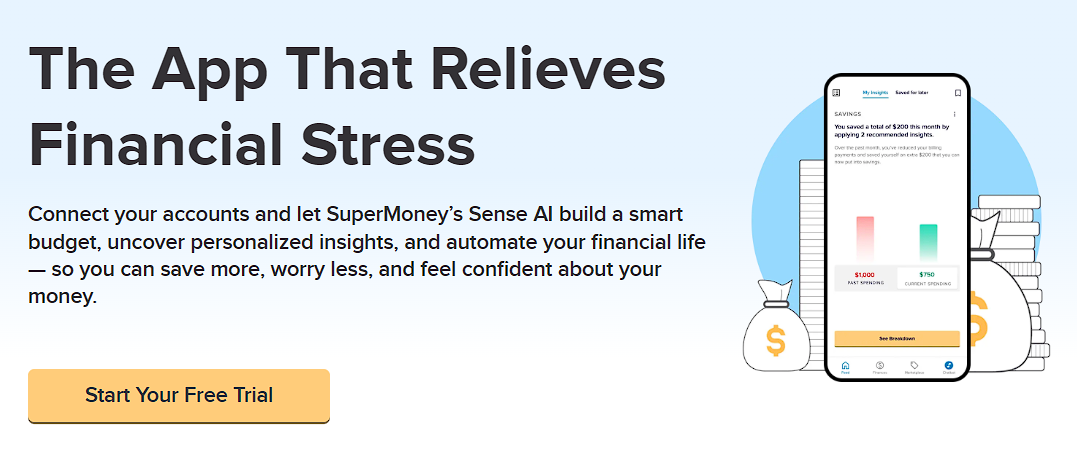
See exactly where your money goes
Track your no-spend days and see real-time spending breakdowns by category. The SuperMoney app shows you which habits cost the most — so you know exactly where the savings come from.
How to Avoid “Revenge Spending” After the Challenge
The biggest risk of a no-spend challenge isn’t quitting early — it’s overspending the moment it ends. Financial experts call this “revenge spending,” and it can erase everything you saved.
CNBC Select reported that some no-spend participants end up spending more in the weeks after the challenge than they would have without it. The restriction creates a scarcity mindset that triggers a spending binge once the rules are lifted.
Three strategies prevent this:
- Move the savings immediately. Transfer everything you saved during the challenge to a separate savings account before the final day. Money that’s out of your checking account is psychologically harder to spend.
- Review your wish list, then wait 48 hours. Everything you wanted during the challenge goes on a list. When the 30 days end, wait two more days before buying anything on it. You’ll find that half the items no longer feel important.
- Keep 2–3 permanent changes. Identify the spending cuts that genuinely didn’t affect your quality of life — maybe you didn’t miss takeout coffee, or canceling a subscription felt like relief, not loss. Keep those cuts and add the savings to a recurring automated transfer.
The goal of the no-spend challenge isn’t to live without spending forever. It’s to make spending intentional — so every dollar that leaves your account is a conscious choice, not a reflex.
Who Should (and Shouldn’t) Try a No-Spend Challenge
It works well for:
- Impulse spenders. If your bank statement surprises you every month with purchases you don’t remember making, the no-spend challenge forces visibility into those patterns.
- People who can budget but can’t stick to it. A challenge provides external structure and a defined endpoint — both of which improve follow-through compared to an open-ended “spend less” resolution.
- Anyone recovering from a high-spending period. Post-holiday debt, vacation spending, or a move — a no-spend month resets the baseline after a financial spike.
- People living paycheck to paycheck who need to free up cash for an emergency fund without earning more money.
It may not be the right fit for:
- People with a history of restrictive financial behavior. If you already under-spend to the point of anxiety, a no-spend challenge can intensify unhealthy patterns rather than build healthy ones.
- Anyone who needs a sustained savings system. A one-time 30-day reset doesn’t replace a budget. If you don’t build a permanent system after the challenge, spending habits revert.
What to Do With the Money You Save
The savings from a no-spend challenge only count if they go somewhere specific. Leaving them in your checking account means they’ll disappear into next month’s spending.
- Start or top up an emergency fund. If you have less than one month of expenses saved, this is the highest-impact use. Even $500 from one no-spend month creates a buffer that prevents credit card debt the next time something breaks.
- Pay down high-interest debt. A $400 lump payment on a credit card at 24% APR saves roughly $96 in annual interest. If you’re weighing the decision, the math on saving vs. paying debt first almost always favors attacking high-interest balances.
- Fund a sinking fund. If you know a large expense is coming — car registration, annual insurance premium, holiday gifts — the no-spend savings create a buffer that absorbs it without disrupting your monthly budget.
- Seed a savings challenge. Use the $300–$750 as a head start on a $5,000 savings goal or the first deposit toward a $10,000 annual target.
Key takeaways
- A no-spend challenge means spending only on essentials (housing, groceries, utilities, transportation, debt payments) for a set period — typically 30 days.
- Most participants save $300–$750 in a single month. Running the challenge quarterly can save $1,200–$3,600 annually without increasing income.
- Set clear rules before day one: list essential categories, list banned categories, and decide gray areas in advance so every purchase isn’t a negotiation.
- The biggest risk is “revenge spending” after the challenge ends — prevent it by moving savings out of checking immediately and keeping 2–3 permanent spending cuts.
- Pair the no-spend challenge with automated savings transfers to turn a temporary reset into a lasting system that builds wealth on autopilot.
FAQ
What are the rules of a no-spend challenge?
You continue paying for essentials — rent, utilities, groceries, transportation, insurance, and debt payments — but stop all discretionary spending for the duration of the challenge. Common banned categories include dining out, online shopping, entertainment, clothing, and impulse purchases. You set the specific rules based on your spending patterns.
How long should a no-spend challenge last?
Thirty days is the most common duration because it’s long enough to reveal spending patterns and break habits. If a full month feels overwhelming, start with a 7-day or 14-day challenge. Even a no-spend weekend builds awareness of automatic spending triggers.
Can I buy groceries during a no-spend challenge?
Yes. Groceries are an essential expense and remain allowed throughout the challenge. The restriction applies to nonessential food spending — restaurants, takeout, delivery apps, and coffee shops. Many participants use the challenge as a reason to cook through their pantry and freezer before buying more groceries.
How much money will I save during a no-spend month?
Most participants save between $300 and $750, depending on their normal discretionary spending. People who typically spend $1,200+ per month on nonessentials can save $650–$900 or more. The exact amount depends on how strictly you define “essential” and how much nonessential spending you normally do.
Is there a no-spend challenge app?
Several budgeting apps support no-spend tracking by categorizing transactions and flagging nonessential purchases. The SuperMoney app tracks spending by category in real time, which helps you see exactly how much you’re saving each day compared to your normal habits.
What if I slip up during the challenge?
One slip doesn’t end the challenge. Log the purchase, note what triggered it, and continue the next day. The value of a no-spend challenge comes from the pattern awareness and the cumulative savings — both of which survive a single mistake. Treat slips as data points, not failures.
How is a no-spend challenge different from a budget?
A budget allocates specific amounts to spending categories every month. A no-spend challenge temporarily eliminates entire categories of discretionary spending. The challenge is a short-term reset designed to reveal habits and free up cash; a budget like the 50/30/20 rule is the long-term system that keeps spending intentional after the challenge ends.
Track your no-spend days and see where your money goes
Connect your accounts, set your challenge rules, and watch your savings grow in real time. The SuperMoney app turns spending awareness into a daily habit — not just a 30-day experiment.
Andrew is the Content Director for SuperMoney, a Certified Financial Planner®, and a Certified Personal Finance Counselor. He loves to geek out on financial data and translate it into actionable insights everyone can understand. His work is often cited by major publications and institutions, such as Forbes, U.S. News, Fox Business, SFGate, Realtor, Deloitte, and Business Insider.
Share this post:
Add as a preferred source on Google
Table of Contents