
Annual Percentage Rate (APR): Definition, Types, and How It’s Calculated

Last updated 03/19/2026 by
Andrew Latham
Edited by
Andrew Latham
Summary:
Annual percentage rate (APR) is the yearly cost of borrowing money, expressed as a percentage of the loan or credit balance, that includes both the interest rate and certain fees charged by the lender.
It is the standardized figure required by law to appear in all credit disclosures, making it the most reliable number to compare the cost of different credit products.
- APR vs. interest rate: The interest rate is the base cost of borrowing. APR includes the interest rate plus certain fees (such as origination fees on loans), making it a broader and more accurate cost figure — especially for loans. On most credit cards, the APR and interest rate are the same because cards don’t typically charge origination fees.
- Multiple APRs on one card: Credit cards carry separate APRs for purchases, balance transfers, cash advances, and a penalty rate. Each applies to a different transaction type.
- Variable vs. fixed: Most consumer credit cards have variable APRs tied to the prime rate, which moves with Federal Reserve decisions. Fixed APRs are rare and can still be changed with advance notice.
- APR vs. APY: APR does not account for compounding. APY (annual percentage yield) does. On savings accounts, APY tells you what you actually earn. On credit cards, APR understates the true cost when interest compounds monthly.
APR appears on every credit card statement, loan disclosure, and mortgage offer — but the same three letters mean slightly different things depending on the product.
Understanding what APR includes, what it excludes, and how it translates into an actual dollar cost is what separates a useful number from a marketing figure.
Compare Credit Cards
Compare the rates, fees, and rewards of leading credit cards.
What Is APR?
APR stands for annual percentage rate. It is the cost of borrowing money expressed as a yearly percentage, standardized so that consumers can compare different credit offers on equal footing.
Federal law — specifically the Truth in Lending Act (TILA) and its implementing regulation, Regulation Z — requires lenders to disclose APR on all consumer credit products before you sign. The disclosure must use a consistent calculation method so that a 20% APR on one card means the same thing as a 20% APR on another.
For credit cards, APR is effectively the same as the interest rate — card issuers don’t typically charge origination fees, so there’s nothing to add on top of the rate. For personal loans and mortgages, APR is higher than the stated interest rate because it folds in fees like origination charges, broker fees, and certain closing costs.
How APR Is Calculated
On credit cards, the issuer converts your APR into a daily periodic rate (DPR) by dividing by 365. That rate is applied each day to your outstanding balance using the average daily balance method — not just to whatever you owe at the end of the month.
At a 22% APR, your daily periodic rate is 22 ÷ 365 = 0.0603% per day. On a $3,000 balance, that generates approximately $1.81 in interest per day, or roughly $54 per month.
For installment loans, APR is calculated differently — it incorporates the loan amount, the interest rate, all required fees, and the repayment schedule into a single annualized figure using a standardized formula. SuperMoney’s APR loan calculator lets you run this calculation for any loan scenario.
| APR | Daily Periodic Rate | Monthly cost on $5,000 | Annual cost on $5,000 |
|---|---|---|---|
| 15% | 0.0411% | ~$62 | ~$750 |
| 20% | 0.0548% | ~$82 | ~$1,000 |
| 22.30% (avg.) | 0.0611% | ~$92 | ~$1,115 |
| 26.99% | 0.0740% | ~$111 | ~$1,350 |
| 29.99% | 0.0822% | ~$123 | ~$1,500 |
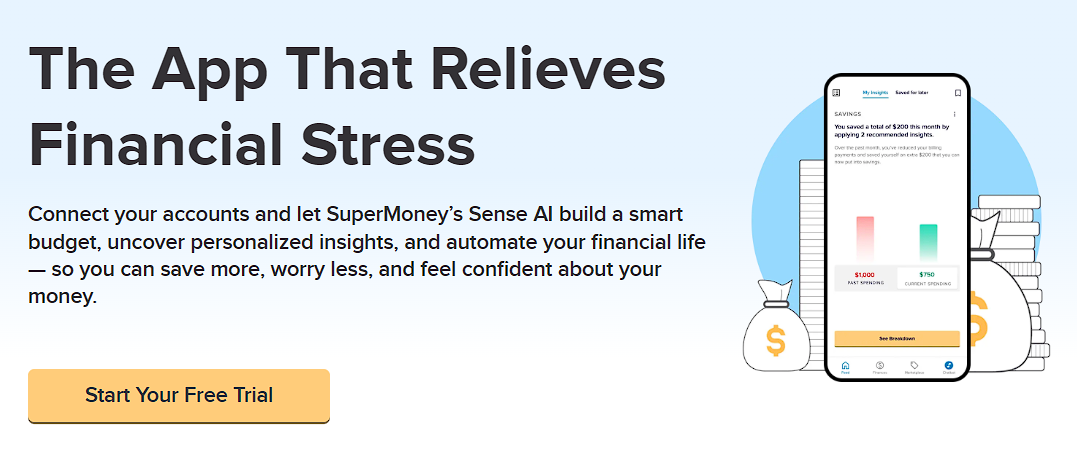 The SuperMoney app shows your APR, current balance, and projected interest charges across all your cards in one view — so you can see exactly what each card is costing you to carry.
Types of APR
Most credit cards carry several different APRs that apply to different transaction types. Your cardholder agreement lists each one.
Purchase APR. The standard rate that applies to everyday purchases when you carry a balance. This is the rate advertised in card offers. It only applies if you don’t pay your full statement balance by the due date — the grace period eliminates purchase interest for cardholders who pay in full each cycle.
Balance transfer APR. Applies to balances moved from another credit card. Many cards offer a 0% introductory APR for 12–21 months on transfers, after which the standard balance transfer rate applies. A transfer fee of 3–5% typically applies upfront.
Cash advance APR. Applies to cash withdrawals at ATMs, bank teller transactions, and certain money transfers. Cash advance APRs are typically higher than purchase APRs — often 25% to 30% — and carry no grace period. Interest begins accruing on the day of the transaction.
Penalty APR. A higher rate — often up to 29.99% — that issuers can apply after a missed or returned payment. Under the Credit CARD Act of 2009, issuers must review accounts on the penalty APR every six months and may restore the standard rate if payment behavior has improved.
Promotional / introductory APR. A temporary reduced rate — often 0% — offered on purchases or balance transfers for a set period, typically 12–21 months. When the promotional window closes, any remaining balance rolls to the standard APR. See SuperMoney’s comparison of cards with a 0% intro APR period to find the longest available offers.
| APR Type | Typical Range | Grace Period? | Trigger |
|---|---|---|---|
| Purchase APR | 18%–30% | Yes | Carrying a balance on everyday purchases |
| Balance transfer APR | 0% promo → 18%–28% | Yes (post-promo) | Transferring a balance from another card |
| Cash advance APR | 25%–30% | No | Cash withdrawal or wire transfer |
| Penalty APR | Up to 29.99% | Yes | Missed or returned payment |
| Promotional APR | 0% for 12–21 mo. | Yes | Intro period on new accounts or transfers |
APR on Credit Cards vs. Loans vs. Mortgages
The same term works differently across product types — which is where most confusion arises.
Credit cards. APR equals the interest rate. There are no origination fees on cards, so nothing is added to the base rate. Interest accrues daily on the average daily balance. The grace period means cardholders who pay in full each month pay 0% effective interest. For a deeper look at how the daily calculation works, see how credit card interest works.
Personal loans. APR is higher than the stated interest rate because it includes origination fees — typically 1%–8% of the loan amount — spread across the loan term. A loan with a 12% interest rate and a 3% origination fee will have an APR closer to 14%–15%, depending on the term length. SuperMoney’s APR loan calculator shows the difference for any combination of rate and fees.
Auto loans. APR on auto loans works similarly to personal loans — the stated rate plus any dealer or lender fees. A strong credit score is the single biggest driver of a lower rate. See SuperMoney’s guide on what is a good APR for a car loan and how to calculate APR on a car loan for product-specific detail.
Mortgages. Mortgage APR includes the interest rate plus discount points, broker fees, mortgage insurance, and most closing costs. On a 30-year mortgage, even a 0.25% difference in APR compounds significantly over the life of the loan — making APR comparison especially valuable here.
APR vs. Interest Rate vs. APY
These three figures are related but measure different things. Mixing them up leads to miscalculated costs and missed savings.
Interest rate is the base cost of borrowing, expressed as a percentage, before any fees are included. It’s the starting point for APR.
APR adds certain required fees on top of the interest rate and annualizes the result. It’s a more complete cost figure than the interest rate alone — but it still doesn’t account for compounding.
APY (annual percentage yield) accounts for compounding — the effect of interest being calculated on previously accrued interest. On savings accounts and CDs, APY tells you what you actually earn. On credit cards, where interest compounds monthly, APY would be slightly higher than APR. A card with a 22% APR, compounded monthly, has an effective APY of approximately 24.4%. SuperMoney’s APR vs. APY explainer covers the full comparison.
| Term | What It Includes | Compounding? | Used For |
|---|---|---|---|
| Interest rate | Base borrowing cost only | No | Starting point for all cost comparisons |
| APR | Interest rate + certain fees | No | Comparing loans, credit cards, mortgages |
| APY | Interest rate + compounding effect | Yes | Savings accounts, CDs; effective cost on cards |
Variable vs. Fixed APR
A variable APR is tied to an index — almost always the U.S. prime rate, which moves directly with Federal Reserve rate decisions. When the Fed raises its benchmark rate, variable APRs rise automatically within one to two billing cycles. When the Fed cuts rates, APRs ease.
Most consumer credit cards carry variable APRs. The national average APR for accounts assessed interest reached 22.30% as of Q4 2025 (Federal Reserve) — up from around 14% in early 2022, tracking the Fed’s aggressive rate-hiking cycle. Three rate cuts in late 2024 and three more in 2025 brought modest relief, but rates remain near historic highs.
A fixed APR does not move with the prime rate. However, “fixed” does not mean permanent — issuers can still raise a fixed APR with 45 days’ advance written notice under the Credit CARD Act. Truly fixed-rate consumer cards are rare today; most fixed-rate credit products are installment loans, not revolving lines.
What Is a Good APR?
Whether an APR is “good” depends on the product type, your credit profile, and current market conditions.
For credit cards, any APR below the national average of 22.30% is favorable. Borrowers with excellent credit (FICO 740+) typically qualify for rates in the 17%–21% range from major issuers. Store cards and cards marketed to borrowers with limited credit history commonly carry rates above 27%.
For auto loans, what counts as a good APR varies significantly by credit tier and whether the loan is new or used. SuperMoney’s guide to good APR for a car loan breaks down current benchmarks by VantageScore range.
For personal loans, a rate below 12% is generally competitive for borrowers with good credit. Rates above 20% on a personal loan often make a balance transfer card or secured loan a better alternative.
For mortgages, APR comparison is most meaningful when comparing loans with similar terms and down payment structures — a 15-year and 30-year mortgage will have different APRs even at the same rate due to fee amortization differences.
How to Get a Lower APR
APR is not fixed at account opening. Several paths lead to a lower rate over time.
Improve your credit score. Credit card APRs are tied to creditworthiness. Moving from good to excellent credit often qualifies you for a lower tier on the card’s variable APR range. See SuperMoney’s guide on what your credit score means for the score ranges issuers use to assign rates.
Call and ask for a reduction. Issuers regularly grant rate reductions to cardholders with a consistent payment history. A LendingTree survey found 76% of cardholders who asked received a lower APR. The ask costs nothing. SuperMoney’s guide on how to get a lower APR on your credit card covers the exact approach and what to say.
Transfer to a 0% intro APR card. A balance transfer card with a 0% intro period effectively sets your APR to zero on transferred balances for 12–21 months, giving you a window to pay down principal without interest accruing.
Wait for rate cuts. If your card has a variable APR, Federal Reserve rate cuts flow through to your APR within one to two cycles. You don’t have to do anything — the rate falls automatically.
Key takeaways
- APR is the annualized cost of borrowing, required by law to be disclosed on all consumer credit products. On credit cards, APR equals the interest rate. On loans and mortgages, APR is higher because it includes fees.
- Credit cards carry multiple APRs — purchase, balance transfer, cash advance, penalty, and promotional. Each applies to a different transaction type, and only cash advances have no grace period.
- Most credit card APRs are variable, tied to the prime rate. The national average for accounts assessed interest was 22.30% as of Q4 2025.
- APR does not account for compounding. APY does. For savings products, compare APY. For borrowing costs, APR is the standard — but the true cost of monthly compounding is slightly higher.
- A lower APR is achievable through credit score improvements, calling your issuer, or moving a balance to a promotional 0% offer.
Frequently Asked Questions
What does APR mean on a credit card?
On a credit card, APR is the annual interest rate applied to any balance you carry from one billing cycle to the next. Unlike loans, credit card APR equals the interest rate exactly — there are no origination fees to include. The rate is converted to a daily figure and applied to your average daily balance throughout the cycle.
Is APR charged monthly or yearly?
APR is an annualized figure, but interest accrues daily and is billed monthly. Your issuer divides the APR by 365 to get a daily rate, applies that rate each day to your average daily balance, and the total appears as a single interest charge on your monthly statement.
Does APR matter if I pay my balance in full?
No — if you pay your full statement balance by the due date every month, your effective interest rate is 0% regardless of your card’s APR. The grace period eliminates all purchase interest. APR only matters when you carry a balance.
What’s the difference between APR and APY?
APR does not account for compounding; APY does. On a credit card that compounds monthly, the true annualized cost is slightly higher than the stated APR. A 22% APR compounded monthly produces an APY of approximately 24.4%. For a full breakdown, see SuperMoney’s APR vs. APY comparison.
Can my APR increase without notice?
On existing balances, no — the Credit CARD Act of 2009 requires 45 days’ advance written notice before an issuer can raise the APR on balances you’ve already accrued. The exception is a penalty APR triggered by a missed payment, which can apply to new transactions immediately. Variable APRs adjust automatically when the prime rate changes, without separate notice required.
How does APR affect my minimum payment?
A higher APR means more of each payment goes toward interest rather than principal. On a $3,000 balance at 22.30% APR, roughly $55 of a $60 minimum payment covers interest — only $5 reduces the balance. See the full breakdown in SuperMoney’s article on minimum credit card payments.
The SuperMoney app compares credit cards by APR, rewards, fees, and credit score requirements — so you can find a lower rate before you carry your next balance.Andrew is the Content Director for SuperMoney, a Certified Financial Planner®, and a Certified Personal Finance Counselor. He loves to geek out on financial data and translate it into actionable insights everyone can understand. His work is often cited by major publications and institutions, such as Forbes, U.S. News, Fox Business, SFGate, Realtor, Deloitte, and Business Insider.
Table of Contents