
How Credit Card Interest Works: APR, Daily Rates, and What You’re Actually Paying

Last updated 05/14/2026 by
Andrew Latham
Edited by
Andrew Latham
Summary:
Credit card interest is the cost your issuer charges for carrying an unpaid balance, calculated by converting your annual percentage rate into a daily rate and applying it to your average balance across the billing cycle.
Understanding the mechanics helps you see exactly when interest applies — and how to avoid it entirely.
- The daily rate: Your APR is divided by 365 to get a daily periodic rate. That rate is applied to your average daily balance every single day of the billing cycle.
- The grace period: If you pay your statement balance in full by the due date, you owe no interest on purchases — the grace period eliminates it entirely. Carrying any balance removes the grace period on new purchases.
- Multiple APRs: Most cards carry separate rates for purchases, cash advances, balance transfers, and a higher penalty APR triggered by missed payments. Cash advances typically start accruing interest immediately — no grace period.
- Current rates: The average APR for accounts being charged interest reached 22.30% as of Q4 2025, near historic highs following years of Federal Reserve rate increases.
Most cardholders know their APR as a number on their statement. Few know how that number translates into an actual dollar charge — or that the calculation runs daily, not monthly, against a balance figure most people never think to track.
Compare Credit Cards
Compare the rates, fees, and rewards of leading credit cards.
What Is Credit Card Interest?
Credit card interest is a fee your issuer charges when you carry an unpaid balance from one billing cycle to the next. It is expressed as an annual percentage rate (APR) — but it accrues daily.
Interest is not charged on purchases you pay off in full by your due date. The grace period your issuer provides — typically 21 to 25 days between your statement close date and your payment due date — exists precisely to let you use the card without paying interest, as long as you clear the balance each cycle.
Once you carry any unpaid balance forward, two things happen: interest accrues on that balance, and new purchases lose their grace period — meaning they start accruing interest from the day they post.
How Your APR Converts to a Daily Rate
Your card’s APR is an annual figure, but credit card issuers charge interest daily. To do that, they divide your APR by 365 to produce a daily periodic rate (DPR).
At the current national average APR of 22.30% for accounts assessed interest (Federal Reserve, Q4 2025), the daily periodic rate is 22.30% ÷ 365 = 0.0611% per day.
That rate is then applied to your balance each day. On a $3,000 balance, that’s $0.0611% × $3,000 = $1.83 in interest per day — roughly $55 per month, or $660 per year on a balance that never moves.
| APR | Daily Periodic Rate | Monthly interest on $3,000 | Annual interest on $3,000 |
|---|---|---|---|
| 18.00% | 0.0493% | ~$44 | ~$540 |
| 20.00% | 0.0548% | ~$49 | ~$600 |
| 22.30% (avg.) | 0.0611% | ~$55 | ~$660 |
| 26.99% | 0.0740% | ~$67 | ~$809 |
| 29.99% | 0.0822% | ~$74 | ~$899 |
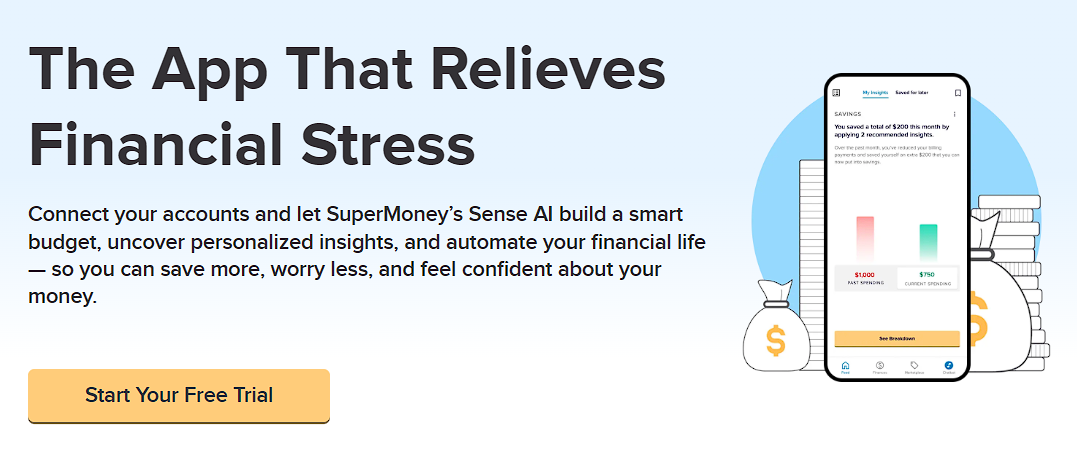 The SuperMoney app shows your current APR, balance, and projected interest charges in one place — so you always know what carrying a balance is actually costing you.
How the Average Daily Balance Method Works
Issuers don’t calculate interest against a single snapshot of your balance. They use the average daily balance method — which means your balance is tracked every day of the billing cycle, and interest is applied to the average of those daily figures.
Here’s how it works in practice. Suppose your billing cycle is 30 days:
- Days 1–10: Balance is $2,000 (10 days × $2,000 = $20,000)
- Days 11–20: You charge $500, balance rises to $2,500 (10 days × $2,500 = $25,000)
- Days 21–30: You make a $300 payment, balance drops to $2,200 (10 days × $2,200 = $22,000)
Total: $67,000 ÷ 30 days = $2,233.33 average daily balance.
Your interest charge for that cycle: $2,233.33 × (22.30% ÷ 365) × 30 days = $46.06.
This is why making purchases early in a billing cycle is more expensive than making them late — an early charge sits in the average balance calculation for more days, generating more interest.
Why partial payments still cost you. If you have a $2,000 balance and pay $1,900 — leaving just $100 unpaid — interest is calculated against your average daily balance for the entire cycle, not just the $100 remaining at cycle close.
The grace period is also suspended. Paying the full statement balance is the only way to avoid interest on purchases entirely.
When Interest Is Charged — and When It Isn’t
Whether you pay interest depends on two things: whether you have a grace period and whether you use it.
Grace period intact. If you paid your previous statement balance in full and on time, your card’s grace period is active. New purchases made during the current cycle will not accrue interest if you pay the full statement balance by the next due date. This is how responsible cardholders use credit cards at no interest cost.
Grace period suspended. Once you carry any unpaid balance — even $1 — from a previous cycle, your grace period is suspended. New purchases begin accruing interest at the daily periodic rate from the day they post. The grace period is not restored until you pay your full statement balance for two consecutive cycles.
Cash advances. Cash advances have no grace period at all. Interest begins accruing the day you take the advance, regardless of whether you otherwise pay your balance in full. Cash advance APRs are also typically higher than purchase APRs — often 25% to 30%.
Types of APR on a Credit Card
Most credit cards carry multiple APRs that apply to different transaction types and situations. Your cardholder agreement lists each one.
Purchase APR. The standard rate that applies to everyday purchases when you carry a balance. This is the rate quoted in most card advertisements and the one most cardholders think of as “the APR.”
Balance transfer APR. Applies to balances moved from another card. Many cards offer a 0% promotional rate for 12–21 months as an incentive to consolidate debt. After the promotional period, the standard balance transfer APR applies — typically equal to or slightly below the purchase APR.
Cash advance APR. Applies to cash withdrawals, wire transfers, and sometimes gambling transactions made with the card. Higher than the purchase APR, with no grace period and typically a transaction fee of 3–5% on top.
Penalty APR. Triggered by a missed or returned payment — often 29.99%. Under the Credit CARD Act of 2009, issuers must review penalty APR accounts every six months and may restore the standard rate if payment behavior improves.
Promotional APR. A temporary reduced rate — often 0% — offered as an introductory incentive on purchases or balance transfers. When the promotional period ends, any remaining balance rolls to the standard APR.
| APR Type | Typical Range | Grace Period? | When It Applies |
|---|---|---|---|
| Purchase APR | 18%–30% | Yes | Everyday purchases when balance carried |
| Balance transfer APR | 0% promo → 18%–28% | Yes (after promo) | Balances transferred from another card |
| Cash advance APR | 25%–30% | No | Cash withdrawals, wire transfers |
| Penalty APR | Up to 29.99% | Yes | After missed or returned payment |
| Promotional APR | 0% for 12–21 mo. | Yes | During intro period on purchases or transfers |
Variable vs. Fixed APR
Most credit cards today carry a variable APR, which is tied to the prime rate — itself directly linked to the Federal Reserve’s benchmark rate. When the Fed raises rates, variable APRs rise automatically. When the Fed cuts rates, APRs ease.
The national average APR peaked at 21.47% in Q4 2024 after a series of Fed rate hikes, then eased slightly to 20.97% across all accounts and 22.30% for accounts actually being charged interest as of Q4 2025, according to Federal Reserve data.
Three Fed rate cuts in late 2024 and three more in late 2025 drove that modest decline — but rates remain near historic highs.
A fixed APR does not change with the prime rate, though issuers can still change it with 45 days’ advance notice under the Credit CARD Act. Truly fixed-rate cards are rare on the consumer market today.
See our guide on how to calculate APR
See our guide on how to calculate APR
How to Stop Paying Credit Card Interest
There are three ways to eliminate credit card interest — each suited to a different situation.
Pay your statement balance in full every month. This is the most straightforward approach. Paying the full statement balance — not just the minimum payment — by the due date keeps the grace period intact and eliminates all purchase interest. Done consistently, you get all the benefits of a credit card with none of the interest cost.
Transfer your balance to a 0% intro APR card. If you’re already carrying a balance, a promotional 0% balance transfer can stop the interest clock for 12–21 months. The transfer fee (typically 3–5%) is a one-time cost, usually far less than months of accumulated interest at 20%+. Use that window to pay down principal aggressively.
Pay off the balance entirely. Once a balance reaches zero, the grace period resets and new purchases stop accruing interest immediately (as long as you pay in full going forward). The how credit cards work article covers the full billing cycle in detail if you want to see exactly where the grace period sits within it.
How to Calculate Your Credit Card Interest Charge
Follow these steps to calculate the interest charge you’ll see on your next statement.
- Find your APR. Check your statement, your online account, or your cardholder agreement. Look for the APR that applies to purchases.
- Calculate your daily periodic rate. Divide your APR by 365. At 22.30% APR: 22.30 ÷ 365 = 0.0611% per day.
- Calculate your average daily balance. Add up your balance at the end of each day in the billing cycle, then divide by the number of days. Your statement may list this directly under the interest charge section.
- Multiply. Average daily balance × daily periodic rate × number of days in the billing cycle = your interest charge. On a $2,500 average daily balance at 22.30% APR over 30 days: $2,500 × 0.000611 × 30 = $45.83.
- Check against your statement. The figure should match the interest charge line on your statement. Small differences may reflect mid-cycle balance changes or rounding.
Frequently Asked Questions
How is credit card interest calculated?
Your issuer divides your APR by 365 to get a daily periodic rate, then applies that rate to your average daily balance — the average of what you owed at the end of each day in the billing cycle.
The result is multiplied by the number of days in the cycle to produce your interest charge for that statement period.
What is a good APR for a credit card?
The national average APR for accounts being charged interest stood at 22.30% as of Q4 2025 (Federal Reserve). Cardholders with excellent credit can qualify for rates in the 17%–20% range.
Any rate below the national average is favorable; rates above 25% — common on store cards and cards marketed to borrowers with limited credit history — are expensive to carry a balance on.
Does the APR change if I miss a payment?
Often, yes. Most cards include a penalty APR — typically up to 29.99% — that issuers can apply after one or two missed or returned payments. The Credit CARD Act of 2009 requires issuers to review accounts on the penalty APR every six months and restore the standard rate if payment history has improved.
The penalty APR does not apply retroactively to existing balances that were already under the standard rate.
Is credit card interest charged monthly or daily?
It accrues daily but is billed monthly. Interest accumulates each day at your daily periodic rate applied to your average daily balance. The total accrued interest for the cycle appears as a single charge on your monthly statement.
How do I know if I’m being charged interest?
Check your statement for a line item labeled “interest charge,” “finance charge,” or “purchase interest.” If your statement balance was paid in full last month and you haven’t taken a cash advance, the charge should be $0.
If you carried any balance, the charge reflects the daily interest that accrued across the billing cycle.
Can I negotiate a lower APR?
Yes — and it’s more effective than most cardholders realize. Issuers regularly grant temporary or permanent rate reductions to cardholders with a solid payment history who call and ask directly.
A 2023 LendingTree survey found that 76% of cardholders who asked for a lower APR received one. A lower APR means more of every payment reduces your principal instead of covering interest.
Key takeaways
- Credit card interest is calculated daily using your APR divided by 365, applied to your average daily balance across the billing cycle.
- The average APR for accounts being charged interest reached 22.30% as of Q4 2025 — near historic highs. At that rate, a $3,000 balance generates roughly $55 in interest per month.
- Paying your full statement balance by the due date eliminates all purchase interest. The grace period only works when the previous balance is paid in full.
- Cash advances carry no grace period — interest begins accruing the day you take them, at a higher APR than purchases.
- Most credit card APRs are variable, tied to the prime rate. When the Federal Reserve raises rates, your card’s APR rises with it.
The SuperMoney app helps you compare credit cards by APR, rewards, and fees side by side — so you can find a card that matches how you actually use credit.Andrew is the Content Director for SuperMoney, a Certified Financial Planner®, and a Certified Personal Finance Counselor. He loves to geek out on financial data and translate it into actionable insights everyone can understand. His work is often cited by major publications and institutions, such as Forbes, U.S. News, Fox Business, SFGate, Realtor, Deloitte, and Business Insider.
Share this post:
Add as a preferred source on Google
Table of Contents