
How to Handle Unexpected Expenses Without Going Into Debt

Last updated 03/18/2026 by
Andrew Latham
Edited by
Andrew Latham
Summary:
Unexpected expenses are unplanned costs — like a medical bill, car breakdown, or job loss — that fall outside your regular monthly budget and require immediate payment. Building even a small emergency buffer of $500 to $1,000 prevents these expenses from forcing you into high-interest debt.
The frustrating part about unexpected expenses isn’t the expense itself — it’s the chain reaction.
One unplanned $800 car repair becomes a credit card balance that takes six months to pay off, which delays every other financial goal you were working toward.
That chain reaction is preventable, and it doesn’t require a massive savings account to stop it.
Compare Savings Accounts
Compare savings accounts. Discover your best option.
What Counts as an Unexpected Expense?
An unexpected expense is any cost that wasn’t part of your regular monthly budget, couldn’t have been reasonably predicted, and requires relatively immediate payment.
The distinction matters because many expenses that feel unexpected are actually predictable — they just aren’t planned for. A flat tire feels like an emergency, but tires wear out on a known schedule.
Holiday gifts feel like a surprise hit to your wallet every December, even though December arrives at the same time every year.
True unexpected expenses include:
- Medical and dental emergencies — an ER visit, emergency surgery, or dental procedure your insurance doesn’t fully cover
- Major car repairs — a transmission failure, engine problem, or accident repair that exceeds routine maintenance
- Job loss or income disruption — layoffs, reduced hours, or the sudden loss of a freelance client
- Essential home repairs — a burst pipe, roof leak, or HVAC failure that can’t wait
- Emergency travel — a last-minute flight for a family medical emergency or funeral
Expenses that are predictable — even if they’re irregular — belong in a sinking fund, not your emergency savings. Car maintenance, annual insurance premiums, back-to-school costs, and holiday spending are all plannable.
Treating them as emergencies is one of the most common reasons people drain their safety net before a real crisis hits.
Not sure if an expense qualifies? Ask yourself three questions: Was it truly unpredictable? Is it urgently necessary? Would skipping it cause serious financial or personal harm? If the answer to all three is yes, it’s an emergency.
If not, it likely belongs in a different savings category. For a deeper framework, see when to use your emergency fund.
How Much Do Americans Actually Have Saved for Emergencies?
The median American has $500 in emergency savings, according to Empower’s 2025 “Safety Net” study — and that number dropped from $600 the previous year.
That $500 wouldn’t cover a single ER visit, a transmission repair, or even one month of rent in most U.S. cities.
The problem is widespread. According to Bankrate’s 2026 Emergency Savings Report, only 30% of Americans would pay for a $1,000 emergency expense from their savings. The rest would go into debt: 25% would put it on a credit card and pay it off over time, 13% would borrow from family or friends, and 5% would take out a personal loan.
Other findings from the Bankrate report:
- 27% of U.S. adults have zero emergency savings — the highest level Bankrate has recorded since it began tracking in 2011
- 54% are saving less for emergencies due to inflation and rising prices
- 68% worry about covering living expenses if they lost their primary income source
- 37% used their emergency savings in the past 12 months
These numbers confirm a pattern: most Americans aren’t one emergency away from financial hardship — they’re already there, operating without a buffer.
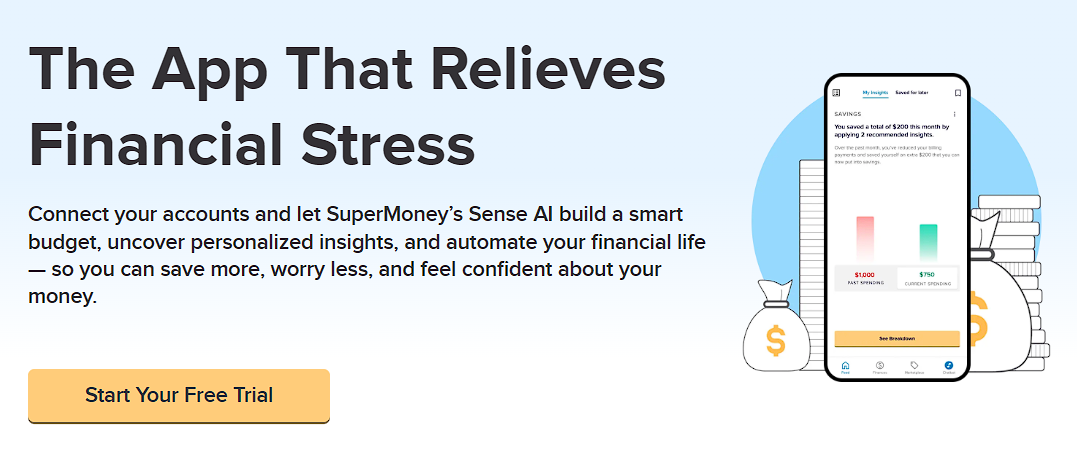
Automate your emergency fund. The SuperMoney app tracks your spending, identifies where you can save, and helps you build an emergency buffer automatically — so you’re prepared for the next unexpected expense before it happens.
Average Emergency Savings by Age
Emergency savings vary dramatically by generation, with older Americans holding significantly more than younger workers who are earlier in their careers and often carrying student debt.
| Generation | Median Emergency Savings | % With 3+ Months Saved | % With No Emergency Savings |
|---|---|---|---|
| Gen Z (18–27) | $400 | 47% | 34% |
| Millennials (28–43) | $500 | 56% | 28% |
| Gen X (44–59) | $500 | 62% | 24% |
| Baby Boomers (60–78) | $2,000 | 78% | 16% |
Sources: Empower “The Safety Net” study (June 2025), Federal Reserve 2024 SHED
The gap between Gen Z’s $400 median and Boomers’ $2,000 reflects more than income differences. Younger workers face higher housing costs relative to wages, carry more student debt, and have had less time to build savings momentum.
The takeaway isn’t that younger Americans are irresponsible — it’s that starting with even a small buffer makes a disproportionate difference. A $1,000 emergency fund eliminates the need for a credit card in most common emergencies, regardless of your age.
How to Calculate Your Emergency Savings Target
Your emergency savings target equals three to six months of essential living expenses — not your total income, and not your total spending, but the minimum you’d need to survive if all non-essential spending stopped.
Here’s the calculation:
- Add up your monthly essentials: housing (rent/mortgage), utilities, groceries, insurance premiums, transportation, minimum debt payments, and any required medications or childcare
- Multiply by 3 for a starter target (stable dual-income households with low fixed costs)
- Multiply by 6 for a full target (single-income households, self-employed, volatile industries, or households with dependents)
| Monthly Essentials | 3-Month Target | 6-Month Target |
|---|---|---|
| $2,000 | $6,000 | $12,000 |
| $3,000 | $9,000 | $18,000 |
| $4,000 | $12,000 | $24,000 |
| $5,000 | $15,000 | $30,000 |
If those numbers feel overwhelming, start smaller.
The Federal Reserve’s 2024 household survey found that the $400 threshold — whether someone can cover a $400 emergency with cash — is the single most cited measure of financial fragility in the U.S. Crossing that threshold, then reaching $1,000, then building to one month of expenses creates real momentum.
How much cash should you actually keep accessible?
The answer depends on your monthly obligations, but even $1,000 in a high-yield savings account separates you from the 27% of Americans with nothing saved at all.
The answer depends on your monthly obligations, but even $1,000 in a high-yield savings account separates you from the 27% of Americans with nothing saved at all.
How to Handle an Unexpected Expense When You Don’t Have Savings
If an unexpected expense hits and your savings can’t cover it, prioritize the options that avoid high-interest debt first.
- Negotiate the bill directly. Medical providers, mechanics, and service companies often offer payment plans at 0% interest or discounted lump-sum settlements. Ask before reaching for a credit card — a $1,200 hospital bill negotiated down to $800 on a payment plan costs far less than $1,200 on a credit card at 22% APR.
- Tap your rainy day fund first. If you keep a separate small cash buffer ($500–$2,000) for minor surprises, use it before touching your primary emergency fund or borrowing.
- Use a 0% APR credit card — carefully. A balance transfer or 0% introductory APR card can buy time if you pay it off within the promotional window. The risk: if you don’t pay it off in time, deferred interest can hit all at once.
- Borrow from family or friends before lenders. An uncomfortable conversation is still cheaper than 20%+ interest. If you go this route, put the repayment terms in writing to protect the relationship.
- Consider a personal loan for larger amounts.Personal loans typically carry lower interest rates than credit cards (6–36% APR vs. 20%+). For expenses over $2,000 that you can’t cover any other way, a fixed-rate loan with a set payoff date is more manageable than revolving credit card debt.
- Avoid payday loans and cash advances. Payday loans carry APRs of 300–400%, and credit card cash advances charge higher rates than purchases plus immediate interest accrual. These options make the financial damage of an unexpected expense dramatically worse.
The goal isn’t to find a perfect solution — it’s to choose the option with the lowest total cost and the shortest path to being debt-free again.
How to Build an Emergency Buffer From Scratch
Starting from $0 is the hardest part. These steps help you build a meaningful buffer in 90 days or less, even on a tight budget. Anyone can build an emergency fund from scratch — the key is starting with a small, achievable target and automating consistent contributions.
- Set a $500 first milestone. Don’t aim for 3–6 months yet. A $500 buffer covers the most common minor emergencies (car tow, urgent care copay, appliance repair) and builds the psychological momentum to keep saving.
- Open a separate high-yield savings account. Keep your emergency fund in a different bank from your checking account. The 1–2 day transfer delay creates a built-in pause that prevents impulse withdrawals. Compare savings accounts to find one with no minimum balance and no fees. Stick with FDIC-insured savings — the federal guarantee protects every dollar up to $250,000 if the bank fails. HYSA vs. CD for your emergency fund: a HYSA keeps your money accessible without penalty, while a CD locks it up — making a CD the wrong choice for money you may need on short notice.
- Automate a small weekly transfer. Even $25/week reaches $500 in 20 weeks. Automating the transfer removes the decision from your hands — the money moves before you can spend it.
- Redirect one windfall. Tax refunds, cash gifts, bonuses, or rebates can jumpstart your fund. The average U.S. tax refund is over $3,000 — directing even half of it to emergency savings can close the gap immediately.
- Cut one recurring expense temporarily. Cancel one subscription, downgrade one service, or meal-prep instead of ordering delivery for a month. Redirect the savings to your emergency fund until you hit your first milestone.
- Scale up after $500. Once you reach $500, increase your weekly transfer and aim for $1,000, then one month of expenses. Each milestone makes the next unexpected expense less financially damaging. For a full automation framework, see the “set it and forget it” money system.
What Is NOT True About Unexpected Expenses?
Several common beliefs about unexpected expenses are misleading or outright false — and believing them can leave you financially exposed.
“Most unexpected expenses are rare.” They’re not. Bankrate’s 2026 report found that 37% of Americans tapped their emergency savings within the past 12 months alone. Unexpected expenses aren’t one-off events — they’re a recurring feature of normal financial life.
“You need thousands of dollars saved to make a difference.” A $500 emergency buffer covers the most common unplanned costs — an urgent care visit, a tow truck, a broken appliance. The gap between $0 and $500 in savings is far more consequential than the gap between $5,000 and $10,000.
“Credit cards are a fine substitute for emergency savings.” Using a credit card for a $1,000 emergency at 22% APR and making minimum payments turns that expense into roughly $1,200–$1,400 over time. Cash savings cost $0 in interest. A credit card is a backup plan, not a strategy.
“Unexpected expenses only happen to people who don’t plan well.” Planning reduces the frequency of financial surprises, but it can’t eliminate them. Medical emergencies, layoffs, and natural disasters affect people at every income and preparation level. An emergency fund exists precisely because not everything can be anticipated.
Common Mistakes That Make Unexpected Expenses Worse
The most expensive mistake isn’t the unexpected expense itself — it’s the financial decisions made in the hours after it hits.
- Panicking and choosing the fastest option, not the cheapest. A credit card cash advance at 25% APR with a 5% fee is fast, but a negotiated payment plan with your mechanic or doctor is almost always cheaper. Take 24 hours before committing to a repayment method.
- Treating predictable irregular expenses as emergencies. Car maintenance, annual insurance premiums, and holiday spending aren’t surprises — they’re planning failures. Routing these into sinking funds instead of your emergency fund keeps your safety net intact for real crises.
- Not rebuilding after a withdrawal. Using your emergency fund is the right move when a real emergency hits. The mistake is failing to replenish it afterward. Treat replenishment as a top-priority budget line item — not something you’ll get around to eventually.
- Keeping emergency savings in your checking account. Money that sits alongside your spending cash gets spent. A separate high-yield savings account earns interest and creates enough friction to prevent casual withdrawals.
- Ignoring the expense entirely. Unpaid medical bills go to collections and damage your credit. Deferred car repairs lead to breakdowns that cost more than the original fix. The cheapest time to handle an unexpected expense is almost always right now — even if the payment method isn’t ideal.
Key takeaways
- Unexpected expenses are unplanned, urgent costs that fall outside your regular budget — medical emergencies, major car repairs, job loss, and essential home repairs are the most common categories.
- The median American has only $500 in emergency savings (Empower 2025). Only 30% would pay for a $1,000 emergency from savings; the rest would go into debt (Bankrate 2026).
- Emergency savings by generation: Gen Z ($400 median), Millennials ($500), Gen X ($500), Boomers ($2,000). A third of Gen Z adults have no emergency savings at all.
- Your target emergency fund is 3–6 months of essential expenses, not total income. Start with $500, then $1,000, then one month — each milestone meaningfully reduces your financial risk.
- When an unexpected expense hits without savings, negotiate the bill first, use a rainy day fund, then consider 0% APR cards or personal loans. Avoid payday loans and credit card cash advances.
- Predictable irregular expenses (car maintenance, holiday gifts, insurance premiums) belong in sinking funds, not your emergency fund. Misclassifying them is the top reason emergency funds get drained.
FAQ
What are the most common unexpected expenses?
The most frequently reported unexpected expenses are medical and dental bills, car repairs, home maintenance emergencies (plumbing, HVAC, roof), job loss or reduced hours, and emergency travel. SuperMoney’s 2025 survey found that 37% of Americans used their emergency savings in the past year, with medical and automotive expenses leading the list.
How much should I have in an emergency savings fund?
Financial experts recommend three to six months of essential living expenses. For a household spending $3,500/month on necessities, that’s $10,500 to $21,000. If that feels out of reach, a $1,000 starter fund covers the majority of common emergencies and prevents credit card debt in most situations.
What helps you prepare for unexpected expenses?
An emergency fund in a separate high-yield savings account is the primary tool. Automating weekly or biweekly transfers builds the fund without relying on willpower. Beyond savings, sinking funds handle predictable irregular costs (so they don’t drain your emergency fund), and adequate insurance coverage reduces out-of-pocket exposure for medical, auto, and home emergencies.
What should I do if I can’t afford an unexpected expense?
Negotiate the bill directly — medical providers and service companies often offer payment plans at 0% interest. If negotiation isn’t possible, a 0% APR credit card or personal loan typically costs less than revolving credit card debt. Avoid payday loans and credit card cash advances, which carry APRs of 25–400% and make the expense significantly more costly.
Is it better to pay off debt or build an emergency fund first?
Build a $1,000 starter emergency fund first, then attack high-interest debt aggressively. Without that baseline buffer, every unexpected expense goes onto a credit card and adds to the debt you’re trying to eliminate — creating a cycle that’s nearly impossible to break. Once your emergency fund hits $1,000, shift focus to the debt-vs-savings prioritization that fits your interest rates and financial situation.
Stop letting unexpected expenses control your finances. The SuperMoney app helps you build an emergency fund, track your spending, and create sinking funds for predictable expenses — so the next surprise doesn’t derail your progress.
Andrew is the Content Director for SuperMoney, a Certified Financial Planner®, and a Certified Personal Finance Counselor. He loves to geek out on financial data and translate it into actionable insights everyone can understand. His work is often cited by major publications and institutions, such as Forbes, U.S. News, Fox Business, SFGate, Realtor, Deloitte, and Business Insider.
Share this post:
Add as a preferred source on Google
Table of Contents