
Inflation Rose to 3.7% in September. Gas Is Up 34%, and That’s Where Your Budget Is Getting Hit

Last updated 10/14/2026 by
SuperMoney Team
Summary:
Inflation rose for the second month in a row, to 3.7% in September from 3.4% in August and 3.0% a year ago. That’s the highest reading since May and nearly double the Federal Reserve’s 2% target. It matters because prices are now rising faster than paychecks, and the Fed is expected to raise rates again, which makes credit cards and HELOCs pricier too. The good news is that the increase is concentrated: gasoline is up 34.2% from a year ago while core prices (everything except food and energy) are up 2.6%. Find the categories doing the damage in your own spending and cut those, not everything.
Inflation went up again. The consumer price index (CPI) rose 3.7% over the 12 months through September, the Bureau of Labor Statistics reported on October 14. That’s up from 3.4% in August and 3.0% a year ago, the second monthly increase in a row, and the highest reading since May’s 4.2%. For context, the Federal Reserve’s goal is 2%, and inflation ran below 3% for most of 2025. So no, this isn’t low. It’s the wrong direction, and it’s stuck well above target.
Here’s why that matters to you. Prices are rising faster than wages: average hourly pay is up 3.0% over the same 12 months, so the typical paycheck buys about 0.7% less than it did a year ago. The Fed raised rates in September to slow inflation down and is expected to do it again, which makes credit cards, HELOCs and car loans more expensive. And on a $5,000-a-month budget, 3.7% works out to about $178 more every month just to buy the same things.
But 3.7% is an average, and averages hide what’s really going on. Prices rose 0.6% in September alone, and gasoline accounted for more than half of that. Most of the rest of the basket stayed calm. That lopsidedness is what makes this round of inflation easier to fight at the kitchen table than the 2022 version, when everything was rising at once. The shape of the problem has been the same since the U.S.-Israeli conflict with Iran pushed oil prices up in late February.
Compare Savings Accounts
Compare savings accounts. Discover your best option.
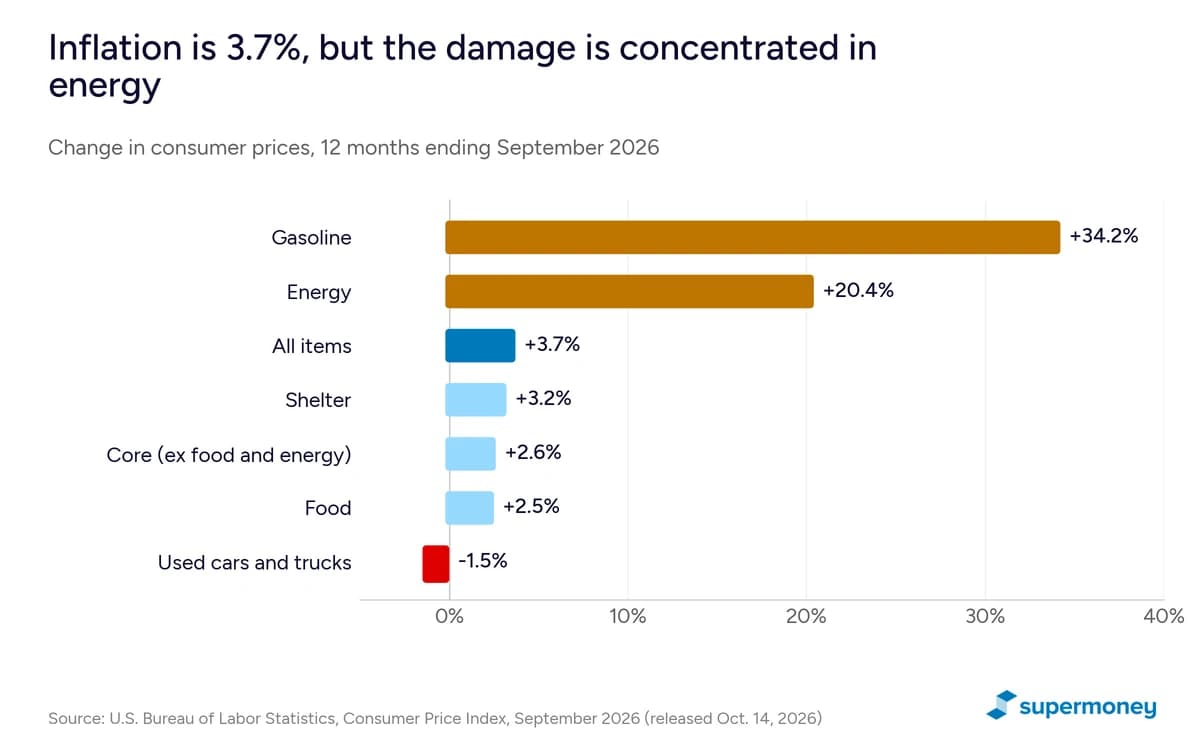
Where prices are rising fast, and where they’re not
| Category | Change over 12 months (September) |
|---|---|
| All items | +3.7% |
| Energy | +20.4% |
| Gasoline | +34.2% |
| Fuel oil | +74.2% |
| Airline fares | +22.4% |
| Shelter | +3.2% |
| Food | +2.5% |
| Core (excluding food and energy) | +2.6% |
| Used cars and trucks | -1.5% |
Read that table twice. Core inflation at 2.6% is close to what economists consider normal. Food at 2.5% and housing costs at 3.2% aren’t pleasant, but they’re not alarming. Grocery prices were actually flat in September, and eggs are down 20.6% from a year ago. It’s energy, and gasoline in particular, that’s pulling the headline number up. Airfares are up 22% for the same reason: jet fuel.
What a 34% jump in gas costs you
Let’s make it concrete. Say you spend $250 a month on gas right now. At a 34.2% increase, that same driving cost you about $186 a year ago. You’re paying roughly $64 more a month, or about $765 a year, for the exact same trips.
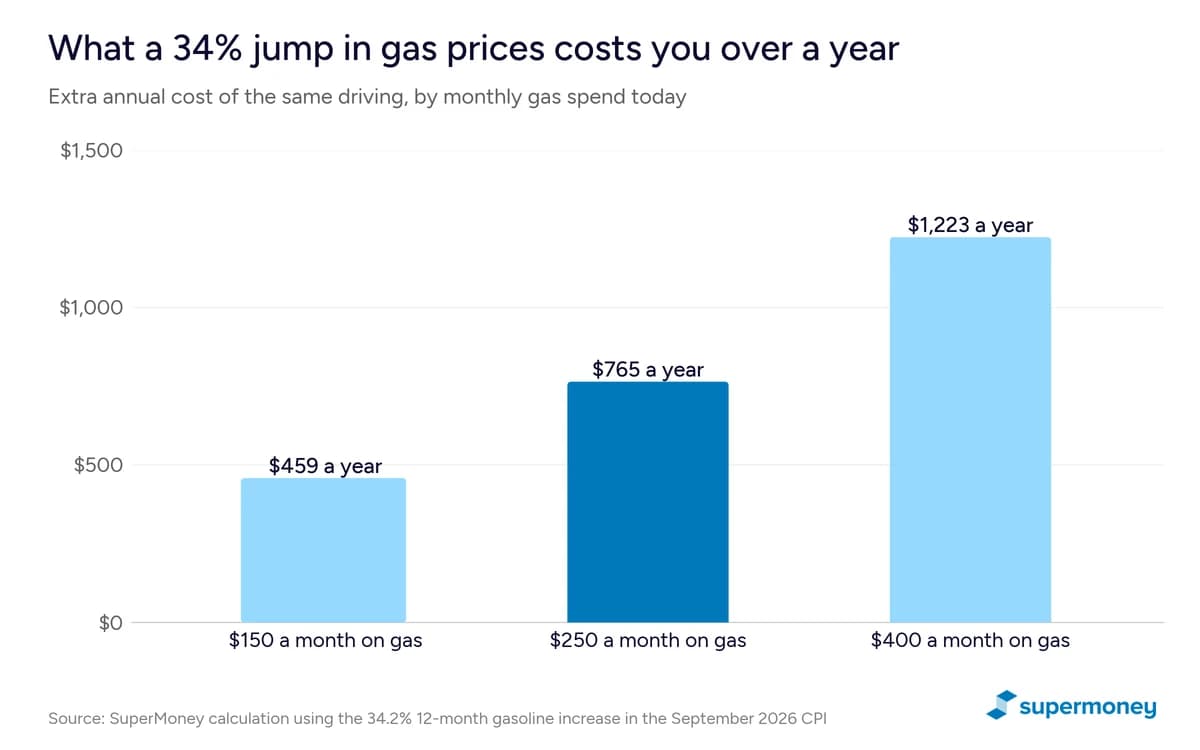
If you commute 40 miles a day in a truck, the number is bigger. If you work from home and drive a hybrid, it’s smaller. Pull up your last three months of fuel charges and you’ll know your real figure in about two minutes.
Now the overall picture. If your total monthly spending is $5,000, a 3.7% year-over-year increase means you need about $178 more a month than you did a year ago, or close to $2,140 over the year. More than a third of that is gas if you drive a lot. The rest is spread thin across groceries, insurance, and housing.
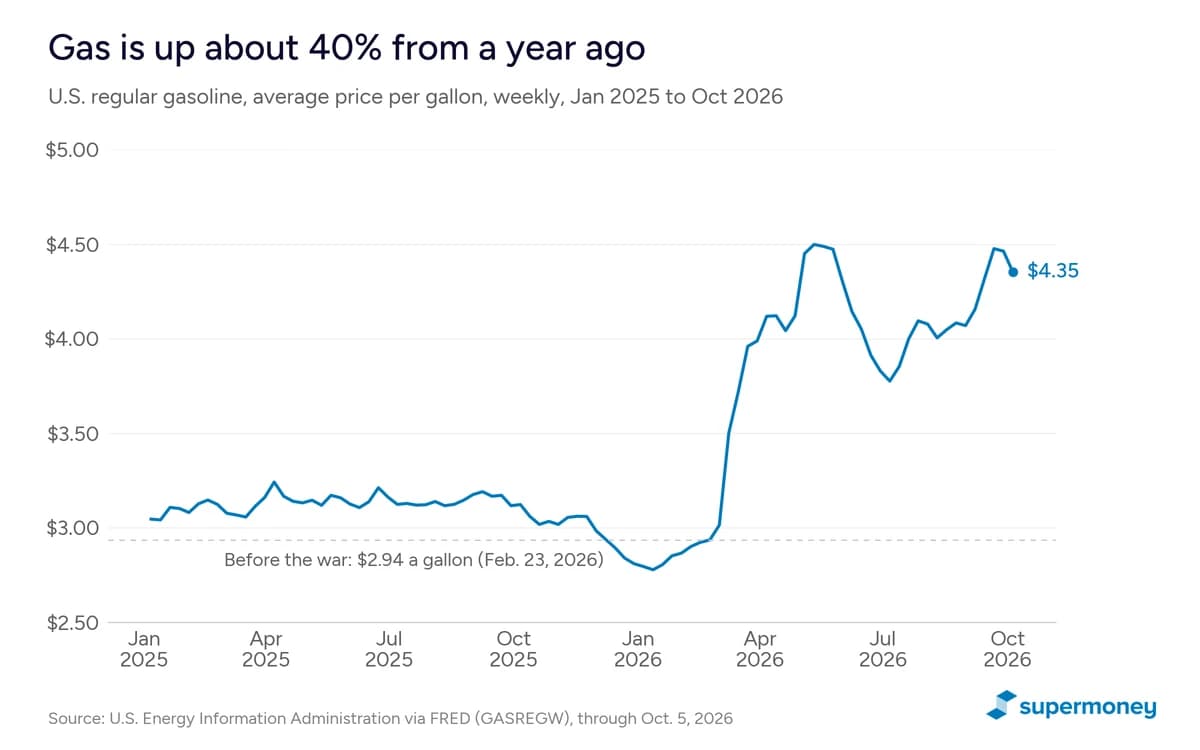
AAA put the national average for regular at $4.33 a gallon on October 14, versus $3.08 a year earlier. Before the war it was just under $3. Diesel is worse, at about $6.30, which is why shipping surcharges are starting to show up in the price of other things you buy.
What today’s report changed
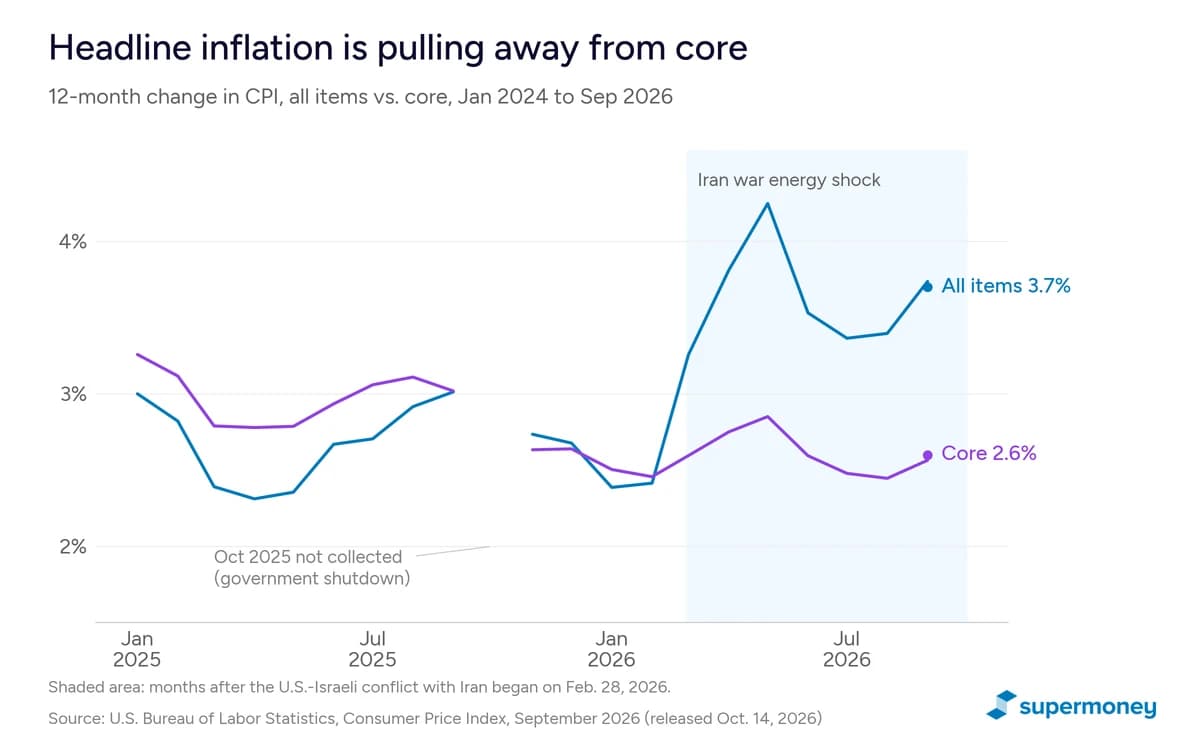
Economists expected headline inflation of 3.6% and core of 2.5%. Both came in a tenth hotter: 3.7% and 2.6%. Core prices rose 0.3% in the month, pushed up by used cars, airline fares, apparel, medical care and recreation. That’s not a blowout, but it’s the wrong direction after core had cooled to 2.4% in August.
Here’s another way to see how lopsided this is. Take gasoline out of the index and prices rose about 2.7% over the past year, versus about 3.1% a year earlier, by our calculation using gasoline’s roughly 3% weight in the CPI. The official measure that strips out all energy tells the same story: 2.6% now, 3.0% a year ago. Inflation excluding the pump is lower than it was last September.
The Federal Reserve raised rates on September 16 for the first time since July 2023, to a range of 3.75% to 4.00%, and said inflation “remains elevated.” Its own projections pencil in one more quarter-point hike by the end of the year. After today’s report, CNBC reported that futures markets put the odds of another hike by December above 96%. The next meeting is October 27 and 28.
If you have a HELOC or a credit card with a variable APR, that’s your cue. Another hike pushes those rates up again within a billing cycle or two, so pay those balances down now rather than wait. Here’s a closer look at what the Fed’s hike actually changes for your debt and savings.
One report doesn’t set your life, though. If the next one is a few tenths off, don’t rewrite your budget over it. Rewrite it when your own bills tell you to.
Why this keeps rates high too
It matters for more than your gas tank. Higher inflation is one reason long-term interest rates have stayed elevated. Freddie Mac reported the average 30-year fixed mortgage rate at 7.40% for the week of October 8, up from 6.30% a year earlier. The 10-year Treasury yield, which mortgage rates follow closely, has hovered between 5.2% and 5.3% this month.
On a $400,000 mortgage, the difference between 6.3% and 7.4% is about $294 a month in principal and interest. So the same inflation story that’s costing you at the pump is also making any borrowing you do more expensive.
That’s a good reason to take care of high-interest debt now. If you’re carrying a credit card balance at 24% APR, you’re on the wrong side of this trade. Paying off $5,000 at 24% saves about $1,200 a year in interest, a guaranteed return no investment will match. If you’re torn between paying it down and building savings, here’s how to decide whether to pay off debt or save.
A simple plan for a lopsided inflation year
Attack the category that’s actually rising. Don’t cut your grocery budget by 10% because inflation is in the news. Food is up 2.5%. Look at fuel instead. Combine errands, check whether your car needs a tire-pressure fix (underinflated tires can lower fuel economy by a few percent), and use a grocery or gas rewards card only if you pay it off in full every month. A 3% gas card on $250 a month earns $90 a year. Nice, but not worth carrying a balance for.
Shop your fixed costs. Shelter is the biggest piece of most budgets and it’s up 3.2%. Renters can compare renewal quotes with market rents before signing. Homeowners can shop insurance, which is the one housing cost you can change without moving, and home insurance premiums now average more than $3,000 a year. Saving $40 a month on car or home insurance is $480 a year.
Make your cash work harder. If your savings account pays 0.5% while inflation runs 3.7%, you’re losing purchasing power every month. On $10,000, that’s about $320 a year in lost buying power. A high-yield savings account paying around 4% flips that. Check current rates before moving money, since they change often, and see where your cash should sit after the Fed’s hike.
Don’t panic about the average. One report doesn’t set your life. What matters is your own spending. Look at the last 90 days and find what’s actually gone up.
How to spend less on gas without driving less
Nobody can cancel their commute the way they cancel a streaming subscription. But a 34% price jump makes the small levers worth pulling, because each one is now a percentage of a bigger number. On $250 a month, every 10% you save is $25 a month, or $300 a year. Here’s what actually moves the needle, using the Department of Energy’s own fuel-economy figures where they exist.
| What to do | What it saves | Why it works |
|---|---|---|
| Slow down on the highway | 7% to 14% | Each 5 mph over 50 mph costs about the same as paying $0.31 more per gallon. Easing off 5 to 10 mph is the biggest single lever most drivers have. |
| Drive smoother | 10% to 40% in stop-and-go traffic, 15% to 30% at highway speeds | Hard acceleration and braking burn fuel. Leave more following distance and coast toward red lights. |
| Skip idling | A quarter to half a gallon per hour | Restarting takes about 10 seconds’ worth of fuel. If you’ll sit for more than a minute, turn it off. |
| Take the roof box off | 6% to 17% on the highway, up to 25% at interstate speeds | Drag is the enemy. A rear-mounted carrier costs only 1% to 5%. |
| Check tire pressure monthly | 0.6% on average, up to 3% | Every 1 psi below spec across all four tires costs about 0.2%. The sticker inside the driver’s door has the right number. |
| Empty the trunk | About 1% per 100 pounds | A set of golf clubs and a bag of salt riding around all winter add up. |
| Use the oil grade in the manual | 1% to 2% | Thicker oil than the engine was designed for creates drag. |
Then there’s where you buy it, which can matter more than how you drive.
- Warehouse clubs. In April 2026, Costco gas ran about 34 cents a gallon below the national average, and Sam’s Club and BJ’s about 26 cents below, according to Oil Price Information Service data reported by CNN. At 40 gallons a month, 30 cents a gallon is about $144 a year, more than most memberships cost.
- Grocery fuel points and price apps. Supermarket chains like Kroger and Safeway knock 10 cents or more per gallon off at partner stations when you shop there anyway. Apps like GasBuddy show the cheapest station near you, and prices in the same metro can differ by 50 cents or more a gallon.
- A rewards card you pay in full. A flat 1.5% to 2% card is fine, and some cards pay 3% or 3x points on gas, which is $90 a year on $250 a month. Compare cash back credit cards, and skip this entirely if you carry a balance. At 24% interest, the rewards disappear in about six weeks.
- Regular, not premium. If your owner’s manual says premium is “recommended” rather than “required,” AAA’s engine testing found no gain in power, fuel economy or emissions from the pricier grade.
None of these offsets a 34% jump on its own. But a lighter foot (7% to 14%), properly inflated tires (up to 3%) and a station that’s 30 cents cheaper (about 7% at today’s prices) add up to roughly 15% to 20% off a gas bill. On $250 a month, that’s $450 to $600 a year, most of the $765 increase, without changing where you go.
A 15-minute check you can do tonight
Open your bank or card statements for the last three months and for the same three months a year ago, if you have them. Add up four categories: fuel, groceries, utilities, and insurance. Divide this year’s total by last year’s. If fuel is up 30% and the rest are up 3%, you’ve found your problem. If everything is up 8%, the answer is different, and you might need a bigger conversation about income or housing.
Most people never do this, and it shows. They feel pressure on their budget, blame “inflation,” and cut randomly. A $50 cut from the wrong category does nothing. A $50 cut from the right one is $600 a year back in your pocket.
Find your own inflation rate
This is where the SuperMoney app helps. Connect your accounts and you can see spending by category, spot subscriptions you forgot about, and compare this quarter’s gas, grocery, and utility bills to last quarter’s. The government number tells you about the average household. Your transactions tell you about yours.
For the bigger picture, including how this energy shock compares with 2022 and the 1970s, what the Fed is projecting, and whether paychecks are keeping up, see our 2026 inflation study, updated with September’s numbers.
Key takeaways
- Inflation rose to 3.7% in September, up from 3.4% in August and 3.0% a year ago, the highest since May. Core inflation was 2.6%.
- Paychecks are falling behind. Average hourly pay is up 3.0%, so real earnings are down about 0.7% from a year ago.
- Energy prices rose 20.4% and gasoline rose 34.2% over 12 months. Gasoline alone drove more than half of September’s monthly increase.
- At $250 a month in gas, that’s about $64 more a month, or $765 a year, for the same driving.
- A $5,000-a-month budget needs about $178 more than a year ago at 3.7% inflation.
- The Fed raised rates to 3.75% to 4.00% on September 16, and markets expect another hike by December. Pay down variable-rate balances first.
- The 30-year mortgage rate averaged 7.40% on October 8, versus 6.30% a year earlier.
Share this post:
Add as a preferred source on Google
Table of Contents