
How To Find Your Routing Number On A Check?

Last updated 11/05/2024 by
Benjamin Locke
Edited by
Andrew Latham
Summary:
In this guide, we explore how to locate your bank’s routing and account numbers on a check, essential for various financial transactions. We also discuss alternatives to find your routing number without a check and provide key takeaways for easy reference
Routing numbers play a pivotal role in the world of banking, serving as the unique identifiers that ensure seamless transactions. Typically found on the bottom left-hand corner of a check, these nine-digit codes are essential for various financial activities, from electronic transfers to direct deposits. But what if you don’t have your checkbook on hand? Fear not, because even without physical checks, there are alternative methods to easily discover your routing number. In this article, we’ll delve into the significance of routing numbers and explore how you can access this crucial information, ensuring your financial transactions proceed smoothly.
Looking for a banking experience that goes further? Check out our fee-free checking account that rewards you every time you use your debit card.
Where are the account and routing numbers on a check?
The first set of numbers on a check, known as the nine-digit bank routing number, plays a crucial role in the functioning of the banking system. This routing number serves as a unique identifier for your financial institution and is utilized for a wide array of transactions, encompassing both traditional paper checks and modern digital equivalents, as well as direct deposits and bill payments.
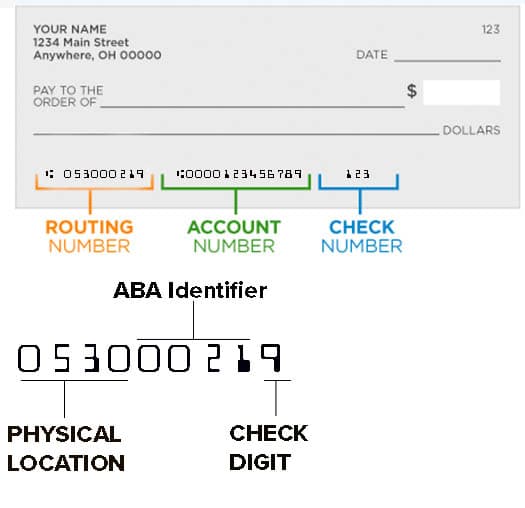
The question often arises: are all check routing numbers nine digits in length? The answer is a resounding yes. These routing numbers adhere to a specific, standardized structure, comprising three distinct components. Firstly, there’s the four-digit Federal Reserve routing symbol, followed by a four-digit ABA institution identifier, and finally, a single check digit to enhance accuracy and security.
But the routing number is just one part of the equation. To the right of the routing number lies the account number, which is unique to your personal account. This second set of numbers can vary in length, depending on your bank, and it distinguishes your specific account from others held at the same institution. Right next to the account number, you’ll find the check number, which serves as an additional layer of individualization, ensuring that each check issued carries a distinct identification number.
How do you find your routing number without a check?
For those who have transitioned to the world of digital banking and no longer rely on paper checks, discovering your routing number is still a straightforward task. You can access this critical information through your account statement or via your bank’s online banking platform or mobile app. Typically, banks display the routing number prominently in the upper-right corner of your monthly statement, alongside their branding and identifying details.
It’s important to recognize that when you initiate a payment, whether electronically or with a traditional paper check, the receiving bank relies on the accuracy of your routing number to identify your financial institution. Therefore, it’s imperative to ensure that you provide the correct routing number to avoid transaction delays. It’s worth noting that some banks may assign different routing numbers for specific states, making precision all the more vital in this interconnected financial landscape.
What is a routing number?
A routing number is a nine-digit numerical code crucial for identifying banks in financial transactions. This unique code ensures that funds are sent to the right bank. The routing number’s first four digits signify the Federal Reserve routing symbol, indicating the Federal Reserve district where the bank is located. The subsequent four digits, known as the ABA institution identifier, are assigned by the American Bankers Association and are vital for differentiating between banks. The final digit, the check digit, is used to confirm the routing number’s validity.
The importance of routing numbers is twofold
| Identification of Financial Institutions | Routing numbers act as unique identifiers for financial institutions. This role became increasingly important with the rise of paper check processing. The use of routing numbers made it simpler to identify which banks were issuing payments on checks, streamlining the transaction process. |
| Facilitating Payment and Clearing Processes | The routing number system played a crucial role in ensuring accurate and efficient financial transactions. It enabled banks to correctly pay patrons on behalf of check-writers. If a check was unfulfillable, the routing number guided the involved parties to the appropriate bank for payment resolution. This improved the efficiency and accuracy of financial transactions, especially when paper checks were the primary non-cash payment method. |
Routing numbers and what they mean
Bank routing numbers consist of a nine-digit sequence and are commonly located at the base of personal checks. Each digit within this code carries a specific significance in identifying financial institutions and their locations. This numerical string facilitates the accurate processing and clearance of financial transactions.
| First two digits | Identify the bank or credit union responsible for clearing financial transactions |
| Next two digits | Represent the bank’s processing center and its location |
| Next four digits | Serve to identify your bank |
| Last digit | Acts as the check digit, verifying the routing number’s validity |
Share this post:
Add as a preferred source on Google
Table of Contents